As a writer with a backlog of unpublished stories and novels, this question concerns and worries me. The Big Five are swallowing up smaller imprints; the corporate houses refuse to read unagented manuscripts; agencies are closed to new clients; self-publishing is turning into a revenue stream for everybody but writers–these are just a few topics worth exploring.
But for today, the topic is horror magazines. Just how many horror fiction periodicals are still out there taking submissions and paying a professional rate? Ever see pictures of magazine stands back in the 30s and 40s? The shelves were so crowded with story-based pulp magazines with those garish, crude, beautiful covers that they looked like a time-lapse slide of cells dividing and subdividing. And that’s exactly what the genres were doing: action divided into western, detective, horror, and war. War divided into sea, land, and air fighting. Air divided into titles focusing on aviators or dogfights or Zeppelins or … you get the picture.
We are in a reverse age: massive cellular collapse. Because the answer to my question, as of September 2025, is one. Uno. Eins. Not nada but its closest neighbor. Right now, only The Dark fits the criteria: horror fiction, professional, and open. And of the others that claim to still be a going concern:
Deadlands plans to reopen to submissions in December of this year
Cosmic Horror Monthly for one week in January of 26
Nightmare “hopes” for January of 26 as well
Pseudopod…is weird to mention; the others do print, electronically at least rather than on paper with all its attendant substantiality. Pseudopod posts audio clips of stories. I guess that counts as a periodical of sorts these days. Regardless, they are closed until Aug 26, when they’ll accept submissions for 10 days.
That’s it. All other titles either shut down or closed to submissions Until Further Notice.
Not much to nurture a community of writers. Not much to keep potential readers interested and entertained. Not much to provide a path to full book publication. Certainly nothing with which to interest the big media of gaming, comics, television, and movies. They get nearly all of their stories in-house. Hard to believe that once upon a time, a show like Alfred Hitchcock Presents could produce 7 seasons of 35+ episodes each, all based on stories from popular mystery magazines like Ellery Queen and Hitchcock’s own.
Which begs the question: how does Ellen Datlow in her yearly series The Best Horror of the Year–entitled with all the same humility that went into naming the “World” Series in baseball–find candidates to fill its table of contents? In a word: anthologies. Are they picking up the slack from the near-extinction of story-based magazines? Well, since many of them are closed to the hoi polloi by the aforementioned gatekeepers of corporations and literary agencies, I’d say no. But that’s a subject for my next newsletter.
Before I sign off, one more question. Am I wrong? I’d love to be. Please comment if you know of any mags I have missed that fit the criteria: horror fiction, professional rates, open to submissions.
Terry Bisson died a year and a month ago. At the time, I knew of only one work by him, the surreal little SF playlet called “They’re Made Out of Meat.” I don’t know why I did not search out more of his writing, but just recently I have. And I’m glad I did. The short story (mainly SF) seems to have been his best form. And he has even shorter pieces — I’ve seen them called dialogues, but playlet works for me — that put his in the territory of Russell Edson and Joe Frank, two of my main dudes. So, here’s a nifty little number called “Toxic Donut”:
HI, I’M RON, the Host’s Chief Administrative Assistant, but you can just call me Ron. Let me begin, at the risk of seeming weird, by saying congratulations.
Of course I know. I’ve been doing this show every year for six years; how could I not know? But look at it this way, Kim—do you mind if I call you Kim? You have been chosen to represent all humanity for one evening. All the birds and beasts too. The worms and the butterflies. The fishes of the sea. The lilies of the field. You are, for one half hour tonight, the representative of all life on the planet. Hell, all life in the Universe, as far as we know. That calls for congratulations, doesn’t it? You have a right to be proud. And your family, too.
Did you, I mean do you have a family? How nice. Well, we all know what they’ll be watching tonight, don’t we? Of course, I know, everybody watches it anyway. More than watch the Academy Awards. Eight to ten points more. A point is about thirteen million people these days, did you know that?
Okay. Anyway. Have you ever been on TV before? “Long shot at a ball game”—that’s good. I loved Bill Murray too. God rest his soul. Anyway. Okay. TV is ninety-nine percent preparation, especially live TV. So if you’ll walk over here with me, let’s take this opportunity to run through the steps for our lighting people, as well as yourself; so you will be able to concentrate on the Event itself.
After all, it’s your night.
Watch your step. Lots of wires.
Okay. We call this Stage Left. At 8:59, one minute to Airtime, one of the Girls will bring you out. Over there, in the little green outfits. What? Since you’re a woman it should be guys in bikinis? I get it, a joke. You have quite a sense of humor, Kim. Do you mind if I call you Kim?
Right, we did.
Anyway. Okay. You’ll stand here. Toes on that mark. Don’t worry, the cameras won’t linger on you, not yet. You’ll just be part of the scene at the beginning. There will be one song from the International Children’s Rainbow Chorus. “Here Comes the Sun,” I think. All you have to do is stand here and look pretty. Dignified, then. Whatever. You’re the first woman in two years, by the way; the last two Consumers were men.
I don’t know why, Consumers is just what we call them; I mean, call you. What would you want us to call you?
That’s another joke, right? Whatever.
Okay. Anyway. Song ends, it’s 9:07. Some business with the lights and the Host comes on. I don’t need to tell you there’ll be applause. He walks straight up to you, and—kiss or handshake? Suit yourself. After the handshake, a little small talk. Where you’re from, job, etc. Where are you from, by the way?
How nice. I didn’t know they spoke English, but then it was British for years, wasn’t it?
Anyway. Okay. Don’t worry about what to say; the Host has been briefed on your background, and he’ll ask a question or two. Short and sweet, sort of like Jeopardy.
To meet him? Well—of course—maybe—tonight right before the show, if time allows. But you have to understand, Mr. Crystal’s a very busy man, Kim. Do you mind if I call you Kim?
Right, we did. I remember. Sorry.
Okay. Anyway. A little ad-lib and it’s 9:10. I have it all here on my clipboard, see? To the minute. At 9:10 there’s some business with the lights, then the Girls bring out the Presidents of the Common Market, the African Federation, the Americas, Pacific Rim, etc. Five gentlemen, one of them a lady this year, I believe. There’s a brief statement; nothing elaborate. “Your great courage, protecting our way of life” sort of thing. A few words on how the Lottery works, since this was the first year people were allowed to buy tickets for others.
I’m sorry you feel that way. I’m sure voluntary would be better. But somebody must have bought you a ticket; that’s the way it works.
Anyway. Okay. Where were we? 9:13, the Presidents. They have a plaque that goes to your family after. Don’t take it; it’s just to look at. Then a kiss; right, handshake. Sorry. I’ll make a note of it. Then they’re out of here, Stage Right. Don’t worry, the Girls manage all the traffic.
Okay. 9:14, lights down, then up on the Native People’s presentation. You’re still standing here, Stage Left, watching them, of course. You might even like it. Three women and three men, clickers and drums and stuff. While the women dance, the men chant. “Science, once our enemy, now our brother” sort of thing. You’ll feel something on the back of your neck; that’s the wind machine. They finish at 9:17, cross to here, give you a kind of bark scroll. Take it but don’t try to unroll it. It’s 9:18 and they’re out of here, Stage Left. That’s the end of the—
What? No, the corporations themselves don’t make a presentation. They want to keep a very low profile.
Anyway. Okay. 9:19 and that’s the end of the warm-up, as we call it. The Host comes back out, and you walk with him—here, let’s try it—across to Center Stage. He’ll help you stay in the spotlight. He admires the scroll, makes a joke, ad-lib stuff; don’t worry about it. He’s done it every year now for six years and never flubbed yet.
There won’t be so many wires underfoot tonight.
Okay. It’s 9:20. You’re at Center Stage, toes here. That’s it, right on the mark. There’s more business with the lights, and the Host introduces the President of the International Institute of Environmental Sciences, who comes out from Stage Left. With the Donut. We don’t see it, of course. It’s in a white paper sack. He sets it here, on the podium in front of you.
He stands out there, those green marks are his—we call him the Green Meany—and gives his Evils of Science rap, starting at 9:22. “For centuries, poisoned the Earth, fouled the air, polluted the waters, etc., etc.” It’s the same rap as last year but different, if you know what I mean. A video goes with it; what we call the sad video. You don’t have to watch if you don’t want to, just look concerned, alarmed, whatever. I mean it all really happened! Dead rivers, dead birds, dioxins. Two minutes’ worth.
Okay. Anyway. It’s 9:24, and he starts what we call the glad video. Blue sky, birds, bears, etc. Gives the Wonders of Science rap where he explains how they have managed to collect and contain all the year’s toxic wastes, pollutants, etc., and keep them out of the environment—
How? I don’t know exactly. I never listen to the technical part. Some kind of submolecular-nano-mini-mumbo-jumbo. But he explains it all, I’m pretty sure. I think there’s even a diagram. Anyway, he explains how all the toxic wastes for the year have been collected and concentrated into a single Donut. The fiscal year, by the way. That’s why the Ceremony is tonight and not New Year’s Eve.
Okay. Anyway. Hands you the bag.
Exits Stage Right, 9:27. Now it’s just you and the Host, and of course, the Donut, still in the bag.
It might be a little greasy. You can hold it at the top if you want to. Whatever.
Anyway. Okay. 9:28. You’ll hear a drumroll. It might sound corny now but it won’t sound corny then. I know because I’ve been here every year for six years, standing right over there in the wings, and I get a tear in my eye every time. Every damn time. The camera pulls in close. This is your moment. You reach in the bag and—
Huh? It looks like any other donut. I’m sure it’ll be glazed, if that’s what you requested.
Okay. Anyway. 9:29, but don’t worry about the time. This is your moment. Our moment, really, everybody in the world who cares about the environment, and these days that includes everybody. You reach in the bag, you pull out the Donut—
What happens next? I get it, still joking. I admire somebody with your sense of humor. Kim.
First published in Esquire, May 1, 1966, this routine (Burrough’s term for his writing jags) was later collected in Exterminator!
Here is Burroughs talking about the story in relation to his creative process in a lecture at the Naropa Institute (Jack Kerouac School of Disembodied Poetics):
Now I get about forty percent of my sets an[d] characters from dreams. Sometimes, just a phrase, a voice, a glimpse, and sometimes I will get a whole story or chapter. All I have to do is sit down and transcribe the dream. An example is a story in Exterminator!called “They Do Not Always Remember” And, sometimes in dreams I find a book or a magazine and read a story. So perhaps writers don’t write, perhaps they just read and transcribe.
Now what are dreams made of? – Much the same material as a novel – pieces of old movies, newspapers, magazines, novels, sensory in-put. The line between subjective and objective experience is purely arbitrary. No objective reality could be experienced without somebody there to experience it subjectively, and no subjective experience could exist without something to experience.
THEY DO NOT ALWAYS REMEMBER
It was in Monterrey Mexico … a square a fountain a café. I had stopped by the fountain to make an entry in my notebook: “dry fountain empty square silver paper in the wind frayed sounds of a distant city.” “What have you written there?” I looked up. A man was standing in front of me barring the way. He was corpulent but hard-looking with a scarred red face and pale grey eyes. He held out his hand as if presenting a badge but the hand was empty. In the same movement he took the notebook out of my hands. “You have no right to do that. What I write in a notebook is my business. Besides I don’t believe you are a police officer.” Several yards away I saw a uniformed policeman thumbs hooked in his belt. “Let’s see what he was to say about this.”
We walked over to the policeman. The man who had stopped me spoke rapidly in Spanish and handed him the notebook. The policeman leafed through it. I was about to renew my prostests but the policeman’s manner was calm and reassuring. He handed the notebook back to me said something to the other man who went back and stood by the fountain.
“You have time for a coffee señor?” the policeman asked. “I will tell you a story. Years ago in this city there were two policemen who were friends and shared the same lodgings. One was Rodriguez. He was content to be a simple agente as you see me now. The other was Alfaro. He was brilliant, ambitious and rose rapidly in the force until he was second in command. He introduced new methods … tape recorders … speech prints. He even studied telepathy and took a drug once which he thought would enable him to detect the criminal mind. He did not hesitate to take action where more discreet officials preferred to look the other way … the opium fields … the management of public funds … bribery in the police force … the behaviour of policemen off duty. Señor he put through a rule that any police officer drunk and carrying a pistol would have his pistol permit canceled for one flat year and what is more he enforced the rule. Needless to say he made enemies. One night he received a phone call and left the apartment he still shared with Rodriguez … he had never married and preferred to live simply you understand … just there by the fountain he was struck by a car … and accident? perhaps … for months he lay in a coma between life and death … he recovered finally … perhaps it would have been better if he had not.” The policeman tapped his forehead “You see the brain was damaged … a small pension … he still thinks he is a major of police and sometimes the old Alfaro is there. I recall an American tourist, cameras slung all over him like great tits protesting waving his passport. There he made a mistake. I looked at the passport and did not like what I saw. So I took him along to the comisaria where it came to light the passport was forged the American tourist was a Dane wanted for passing worthless checks in twenty-three countries including Mexico. A female impersonator from East St Louis turned out to be an atomic scientist wanted by the FBI for selling secrets to the Chinese. Yes thanks to Alfaro I have made important arrests. More often I must tell to some tourist once again the story of Rodriguez and Alfaro.” He took a toothpoick out of his mouth and looked meditatively at the end if ot. “I think Rodriguez has his Alfaro and for every Alfaro there is always a Rodriguez. They do not always remember.” He tapped his forehead. “You will pay for the coffee yes?”
I put a note down on the table. Rodriguez snatched it up. “This note is counterfeit señor. You are under arrest.” “But I got it from American Express two hours ago!” “Mentiras! You think we Mexicans are so stupid? No doubt you have a suitcase full of this filth in your hotel room.”
Alfaro was standing by the table smiling. He showed a police badge. “I am the FBI señor … the Federal Police of Mexico. Allow me.” He took the note and held it up to the light smiling he handed it back to me. He said something to Rodriguez who walked out and stood by the fountain. I noticed for the first time that he was not carrying a pistol. Alfaro looked after him shaking his head sadly. “You have time for a coffee señor? I will tell you a story.” “That’s enough!” I pulled a card out of my wallet and snapped crisply “I am District Supervisor Lee of the American Narcotics
Department and I am arresting you and your accomplice Rodriguez for acting in concert to promote the sale of narcotics … caffeine among other drugs …”
A hand touched my shoulder. I looked up. A greyhaired Irishman was standing there with calm authority the face portentous and distant as if I were recovering consciousness after a blow on the head. They do not always remember. “Go over there by the fountain Bill. I’ll look into this.” I could feel his eyes on my back see the sad head shake hear him order two coffees in excellent Spanish … dry fountain empty square silver paper in the wind frayed sounds of distant city … everything grey and fuzzy … my mind isn’t working right … who are you over there telling the story of Harry and Bill? … The square clicked back into focus. My mind cleared. I walked toward the café with calm authority.
“For Openers (Lost Jazz Bars in Four-Time)”, a music video from Grammy Award, Pulitzer Prize-nominated audio journalist MICHAEL C FORD from the album “Look Each Other In The Ears” (Hen House Studios).
Don’t know Ford? Then Ford Word March! Legendary voice on the LA poetry scene, MICHAEL C FORD has produced a steady stream of print and recorded product since 1970.
His debut spoken word vinyl {on SST} LANGUAGE COMMANDO earned a Grammy nomination in 1986.
His book of Selected Poems entitled EMERGENCY EXITS was honored by a 1998 Pulitzer Prize nomination.
Michael’s New record: MICHAEL C FORD – LOOK EACH OTHER IN THE EARS, featuring The Doors members Ray Manzarek, Robby Krieger and John Densmore can be found at Amazon.com
Emergency Exits [ Selected Poems: 1970-1995] 1998 Pulitzer nomination – REVIEW – Michael C Ford immortalizes and, in many instances, resurrects not only past popular iconic figure, but those neglected regions and landmarks from the Pacific Northwest to the shores of Lake Michigan, marking passages of time in America. – Los Angeles Times
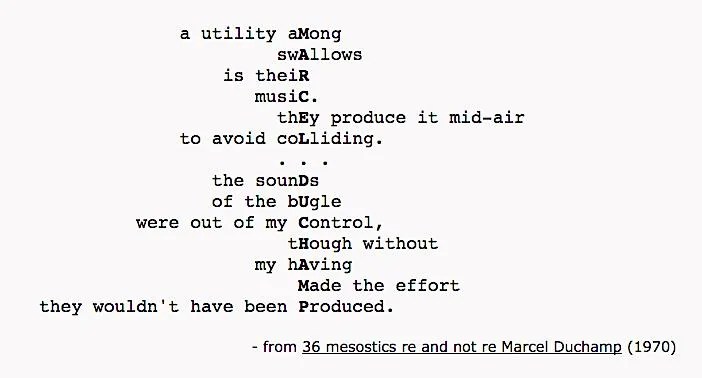
The reputation of John Cage rests primarily on his work as a composer. Am I wrong? Could be. For some he is a speaker, performer, and theorist whose collections of lectures and anti-lectures such as A Year from Monday and Silence have been life altering. His work in poems and anti-poems constitute another area of influence. (That “anti” stuff is clunky, I know, but his work floats on such peripheries as to make usual generic discussion impossible; see the transcription of Empty Words below). What they have in common is improvisation.
Maybe. I have been told by jazz musicians that improv in jazz is never spontaneous, is instead a very intentional process of disassembly and reassembly. Fine, then Cage’s improv goes much farther. It is based on chance. Here’s an excerpt from Marjorie Perloff’s “poetry on the Brink” about Cage:
The main charge against Conceptual writing is that the reliance on other people’s words negates the essence of lyric poetry. Appropriation, its detractors insist, produces at best a bloodless poetry that, however interesting at the intellectual level, allows for no unique emotional input. If the words used are not my own, how can I convey the true voice of feeling unique to lyric?
With thousands of poets jostling for their place in the sun, a tepid tolerance rules.
This is hardly a new complaint: it was lodged as early as the 1970s against John Cage’s writings-through—texts, usually lineated, composed entirely of citations, with source texts ranging from Joyce’s Finnegans Wake to the notebooks of Jasper Johns. Here, for example, is a passage from “Writing for the first time through Howl” (1986):
Blind in thE mind towaRd illuminatinG dAwns bLinking Light thE wiNter liGht endless rIde BroNx wheelS Brought thEm wRacked liGht of zoo
The source of these minimalist stanzas is the following set of strophes, whose erasure, based on what Cage has called the “50% mesostic” rule, uncovers the thirteen letters ALLENGINSBERG required for the vertical mesostic string. I have highlighted Cage’s chosen words, here beginning with the “B” for “–BERG.”
incomparable blind streets of shuddering cloud and lightning in the mind leaping toward poles of Canada & Paterson, illuminating all the motionless world of Time between,
Peyote solidities of halls, backyard green tree cemetery dawns, wine drunkenness over the rooftops, storefront boroughs of teahead joyride neon blinking traffic light, sun and moon and tree vibrations in the roaring winter dusks of Brooklyn, ashcan rantings and kind king light of mind,
who chained themselves to subways for the endless ride from Battery to holy Bronx on benzedrine until the noise of wheels and children brought them down shuddering mouth-wracked and battered bleak of brain all drained of brilliance in the drear light of Zoo
Cage’s elliptical lyric functions as both homage and critique, subtly interjecting his own values into the exuberant, hyperbolic Howl. As hushed and muted as Ginsberg’s baroque “ashcan rantings” are wild and expansive, Cage’s poem is a rhyming nightsong, whose referents are elusive, with only the movement toward the “BroNx” transforming the “linking” of the “blinking / light” to one that is “wRacked” with “light of Zoo.” Without deploying a single word of his own, Cage subtly turns the language of Howl against itself so as to make a plea for restraint and quietude as alternatives to the violence at the heart of Ginsberg’s poem.
There is further dialogue between the two poems. For Ginsberg, sound and visual configuration support the poet’s exclamatory particulars, the urgent things he wishes to say, whereas for Cage poetry is, by definition, first and foremost a visual and sound structure. Poetry is not poetry, as he put it, “by reason of its content or ambiguity but by reason of its allowing musical elements (time, sound) to be introduced into the world of words.”
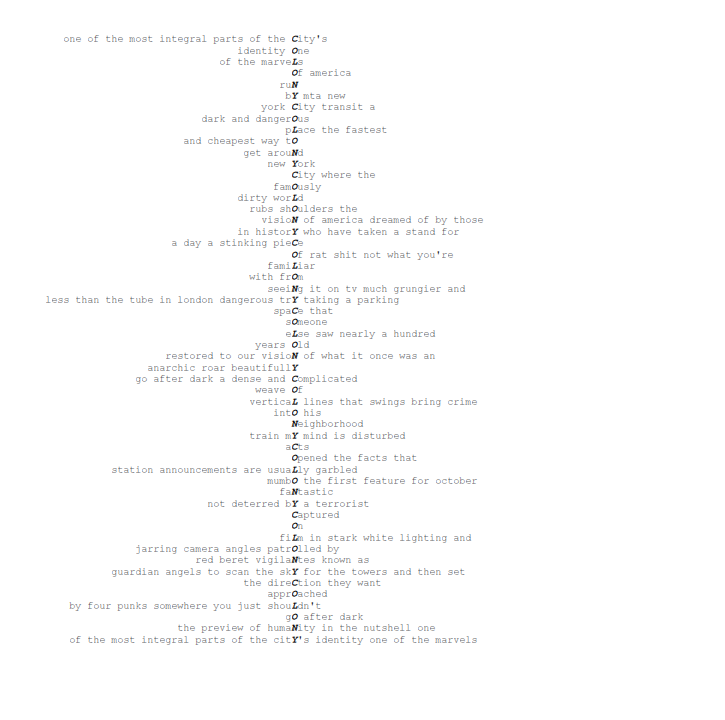
Cage’s mesostic may be difficult to make out there, so a graphic might work better:
Then again, the best way to understand it might be to try to write one yourself (dare I say “anti-write” since once again, the process violates all those tropes about originality that have been drummed into us) at this site where a software program has automated the process. I’ve used it myself, enjoying the concrete nature of the form:
Just to show how far chance can go with Cage, here is an attempt to transcribe a little of his Lecture IV the fourth part of Empty Words, which, as described on his webpage: “a marathon text drawn from the Journals of Henry David Thoreau. This is one of Cage’s most sustained and elaborate moves toward the “demilitarization” of language, in four parts: Part I omits sentences, Part II omits phrases, and Part III omits words. Part IV, which omits syllables, leaves us nothing but a virtual lullaby of letters and sounds.”
3 XI 325-7 ry 4 II 430-2t um 5 I 174-6 me 6 XIV 332-4 for 7 XIII 24-6 be
and so on.
It’s not “I wandered lonely as a cloud…” But then we already have that, so why not keep moving into new territory?




 Jedediah Smith