From pulp horror to avant garde poetics, writing that hits hard by Jedediah Smith

Tag: poetry

  • Monday Composition: Learning to Dance

    Learning to Dance

    A young boy kept his neighbor’s foot under his bed. It lay among the dust bunnies, idle, bereft, still wearing its oxblood leather shoe. The boy had not forgotten the foot, but he rarely took it out anymore.

    Months before, the boy had stolen it on impulse. He had seen his elderly neighbor napping in a hammock in his backyard. Cleverly, he took the foot without waking the old man.  

    For a while, the boy thought the foot a marvelous toy. He made it march about his room. It would kick through the boy’s green plastic army men in great mock battles. He dressed it in his mother’s pumps, painted the toes, and practiced his pose. Occasionally, the boy would feed the foot, peeling back the shoe’s tongue and tenderly hand-feeding it oats or kernels of corn. 

    With time, the games grew crueler. The boy would swell like a lion and ambush the foot or tickle its arch until it cringed in a corner. But soon he became bored and ignored the foot and felt depressed.

    The boy turned to his neighbor for help.

    I have lost all joy in the things of this world, the boy would say.

    The old man could only weep, while hopping on one foot. 

    Life seems very long, the boy would cry. How my days stretch before me.

    After weeks of such talk, the old man spoke. Give me your hand, he said. I’ll teach you to dance. 
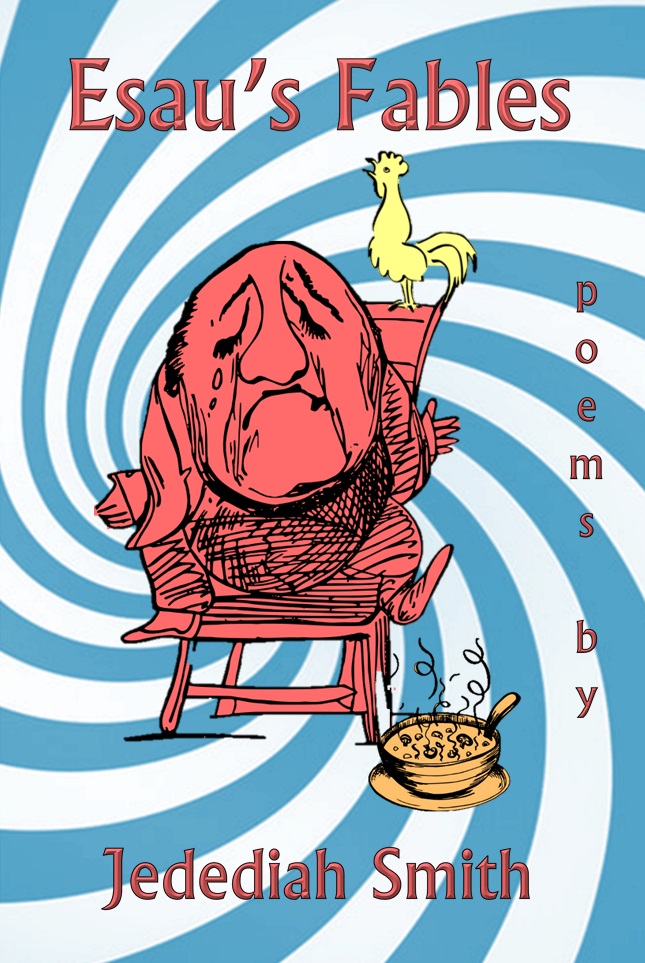
    Selected from Esau’s Fables by Jedediah Smith. Available in paperback from Amazon.

  • Just Published! No va: poems

    My December book is out now from Mount Diablo Books. No va. Possibly a poem. Possibly an urban myth about the Chevy Nova in Spain. Possibly a variation of Georges Perec’s MICRO-TRADUCTIONS, 15 discrete variations on a known poem. Certainly based on Arthur Rimbaud’s short prose poem “Fête d’Hiver” from Illuminations. No va presents 22 variations by constraint on each of the 22 keywords in Rimbaud’s original the car sold poorly because its name “Nova” translates to “doesn’t go” in Spanish.

    The variations are examined carefully via an engine diagram exploded view as might be found in the Motor Auto Repair Manual, perhaps circa 1980. Possibly a sub-category in translations: that of variations; on the other hand, within these variations, it specifies a particular domain: discrete variations, essentially meaning people thought the car wouldn’t work properly. The exploded view is then imploded to create a series of 22 new, or newish, poems; however, this is completely false, as “nova” in Spanish means the same as in English, “new,” and supernova means super new.

    No va is in flight, or on a leisurely drive, from originality, subjectivity, and realism and toward quantum physics, supernovae, expanding space, rubber soul, and “When Yuba Plays the Rumba on the Tuba” played by Bugs on a sousaphone. The misconception arises from the phrase “no va” in Spanish which means “doesn’t go,” but you need to add an expansion of space between “no” and “va” to get that meaning, which most people wouldn’t automatically do when seeing “Nova.”

    Using the glossary-generated restraints from the first two sections, No va proceeds to create reimaginactaments of Rimbaud’s Lettre de voyant to Paul Demeny and his poem Le Bateau ivre. Very likely this is the inaugural work in the school of Trailer Park OuLiPo. The Chevy Nova sold well in Spanish speaking countries.