An average joe comes in and orders thirty cheeseburgers and thirty fries.
I wait for him to pay before I start cooking. He pays. He ain’t no average joe.
The grill is just big enough for ten rows of three. I slap the burgers down throw two buckets of fries in the deep frier and they pop pop, spit spit. . . pssss. . . The counter girls laugh. I concentrate. It is the crucial point– they are ready for the cheese: my fingers shake as I tear off slices toss them on the burgers/fries done/dump/ refill buckets/burgers ready/flip into buns/ beat that melting cheese/wrap burgers in plastic/ into paper bags/fried done/dump/fill thirty bags/ bring them to the counter/wipe sweat on sleeve and smile at the counter girls. I puff my chest out and bellow: Thirty cheeseburgers! Thirty fries! I grab a handful of ice, toss it in my mouth do a little dance and walk back to the grill. Pressure, responsibility, success. Thirty cheeseburgers, thirty fries.
Feeling the need of increased stature among his peers, Pepkin decided to grow a beard like those of the great philosophers or Tolstoy or Brahms, and so he stopped shaving. When his beard came in though, it came not as many hairs but one enormous whisker. It grew just above the jawline of his right cheek and resembled a tree trunk. Since it lacked the look of a conventional beard, he thought about shaving it off but decided to give it some time and see how it developed.
As it grew longer, it continued to thicken and soon grew quite heavy. He found himself tilting his head to the right most of the time, as one with classic paralysis of the fourth cranial nerve, and people thought it gave him a contemplative air. In fact he found himself being given considerations he never had before. Friends would listen attentively as he spoke. Strangers would ask him to opine on matters of the day. Clergy sought his advice on matters both theological and lay. Pepkin noticed other men adopting what had come to be called the Pepkin Tilt.
He worried this imitation might dilute his uniqueness, but it was about this time his enormous whisker began to sprout fruit. At first they were just small green nuts clustered at the end of the whisker, but over time they blanched until they looked like pulpy white berries. The weight of the fruit and the still-growing whisker itself caused it to bend down, and the fruit would sway and slap against Pepkin’s chest as he walked. While some men tried to mimic this look as well, with beaded scarves or lengths of pasta, the consensus was that Pepkin had taken his innovation too far. He found himself shunned.
So, he stayed in his apartment more and more, then retreated even farther, rarely leaving his bedroom. Finding the open space of the vast room vertiginous, he constructed a canopy over his bed and brooded inside. After several weeks within this crib, his fleshy berries began to split and ooze a viscous liquid. From within, little baby snakes emerged, each with a face identical to Pepkin’s. When all the snakes had hatched, he took a razor and shaved off his enormous whisker. From its fine-grained substance, he built a boat and sailed it out to sea. The snakes sunned themselves on the deck while Pepkin steered the wheel.
Those who saw them go tried to tell the story of their departure, but few would believe them. So, the storytellers formed their own clubs and societies. They would take turns retelling the tale of Pepkin. They called it “tilting.”
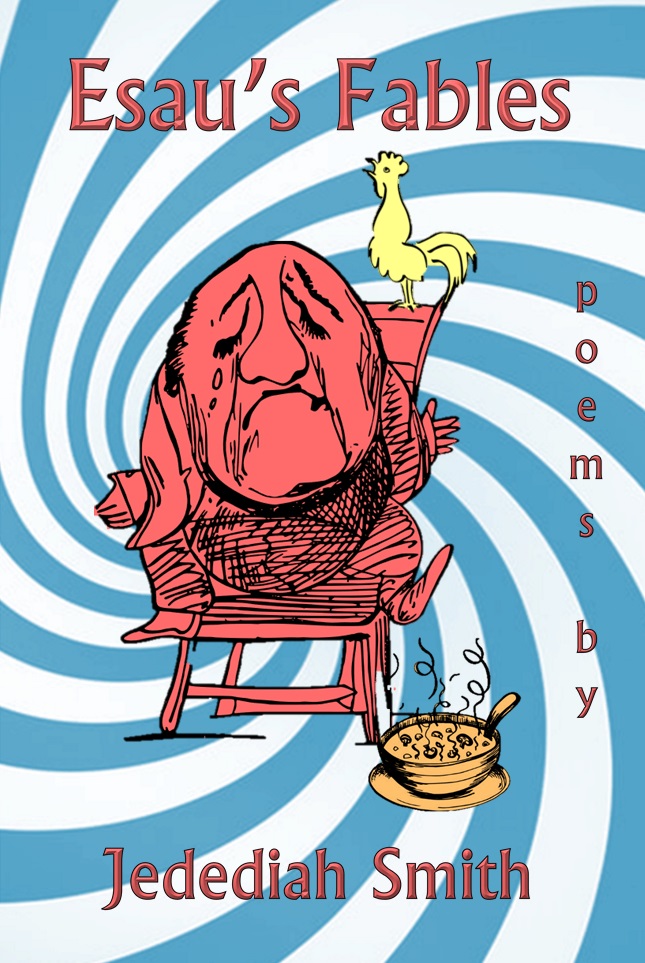
A selection from Esau’s Fables, published by Mount Diablo Books and available in print and, as of this week, as an e-book from Amazon. The piece also appeared previously in Flash Fiction Magazine.
“For Openers (Lost Jazz Bars in Four-Time)”, a music video from Grammy Award, Pulitzer Prize-nominated audio journalist MICHAEL C FORD from the album “Look Each Other In The Ears” (Hen House Studios).
Don’t know Ford? Then Ford Word March! Legendary voice on the LA poetry scene, MICHAEL C FORD has produced a steady stream of print and recorded product since 1970.
His debut spoken word vinyl {on SST} LANGUAGE COMMANDO earned a Grammy nomination in 1986.
His book of Selected Poems entitled EMERGENCY EXITS was honored by a 1998 Pulitzer Prize nomination.
Michael’s New record: MICHAEL C FORD – LOOK EACH OTHER IN THE EARS, featuring The Doors members Ray Manzarek, Robby Krieger and John Densmore can be found at Amazon.com
Emergency Exits [ Selected Poems: 1970-1995] 1998 Pulitzer nomination – REVIEW – Michael C Ford immortalizes and, in many instances, resurrects not only past popular iconic figure, but those neglected regions and landmarks from the Pacific Northwest to the shores of Lake Michigan, marking passages of time in America. – Los Angeles Times
The reputation of John Cage rests primarily on his work as a composer. Am I wrong? Could be. For some he is a speaker, performer, and theorist whose collections of lectures and anti-lectures such as A Year from Monday and Silence have been life altering. His work in poems and anti-poems constitute another area of influence. (That “anti” stuff is clunky, I know, but his work floats on such peripheries as to make usual generic discussion impossible; see the transcription of Empty Words below). What they have in common is improvisation.
Maybe. I have been told by jazz musicians that improv in jazz is never spontaneous, is instead a very intentional process of disassembly and reassembly. Fine, then Cage’s improv goes much farther. It is based on chance. Here’s an excerpt from Marjorie Perloff’s “poetry on the Brink” about Cage:
The main charge against Conceptual writing is that the reliance on other people’s words negates the essence of lyric poetry. Appropriation, its detractors insist, produces at best a bloodless poetry that, however interesting at the intellectual level, allows for no unique emotional input. If the words used are not my own, how can I convey the true voice of feeling unique to lyric?
With thousands of poets jostling for their place in the sun, a tepid tolerance rules.
This is hardly a new complaint: it was lodged as early as the 1970s against John Cage’s writings-through—texts, usually lineated, composed entirely of citations, with source texts ranging from Joyce’s Finnegans Wake to the notebooks of Jasper Johns. Here, for example, is a passage from “Writing for the first time through Howl” (1986):
Blind in thE mind towaRd illuminatinG dAwns bLinking Light thE wiNter liGht endless rIde BroNx wheelS Brought thEm wRacked liGht of zoo
The source of these minimalist stanzas is the following set of strophes, whose erasure, based on what Cage has called the “50% mesostic” rule, uncovers the thirteen letters ALLENGINSBERG required for the vertical mesostic string. I have highlighted Cage’s chosen words, here beginning with the “B” for “–BERG.”
incomparable blind streets of shuddering cloud and lightning in the mind leaping toward poles of Canada & Paterson, illuminating all the motionless world of Time between,
Peyote solidities of halls, backyard green tree cemetery dawns, wine drunkenness over the rooftops, storefront boroughs of teahead joyride neon blinking traffic light, sun and moon and tree vibrations in the roaring winter dusks of Brooklyn, ashcan rantings and kind king light of mind,
who chained themselves to subways for the endless ride from Battery to holy Bronx on benzedrine until the noise of wheels and children brought them down shuddering mouth-wracked and battered bleak of brain all drained of brilliance in the drear light of Zoo
Cage’s elliptical lyric functions as both homage and critique, subtly interjecting his own values into the exuberant, hyperbolic Howl. As hushed and muted as Ginsberg’s baroque “ashcan rantings” are wild and expansive, Cage’s poem is a rhyming nightsong, whose referents are elusive, with only the movement toward the “BroNx” transforming the “linking” of the “blinking / light” to one that is “wRacked” with “light of Zoo.” Without deploying a single word of his own, Cage subtly turns the language of Howl against itself so as to make a plea for restraint and quietude as alternatives to the violence at the heart of Ginsberg’s poem.
There is further dialogue between the two poems. For Ginsberg, sound and visual configuration support the poet’s exclamatory particulars, the urgent things he wishes to say, whereas for Cage poetry is, by definition, first and foremost a visual and sound structure. Poetry is not poetry, as he put it, “by reason of its content or ambiguity but by reason of its allowing musical elements (time, sound) to be introduced into the world of words.”
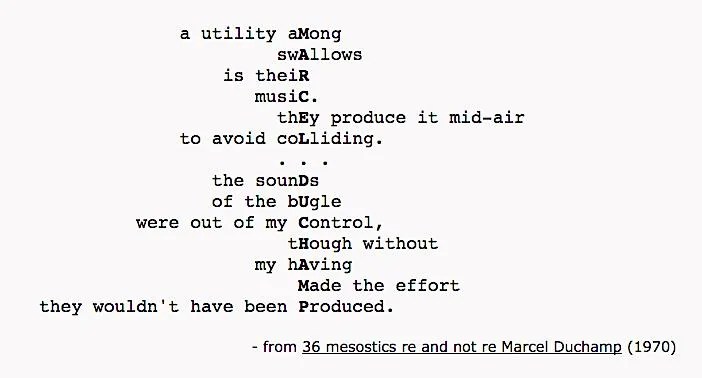
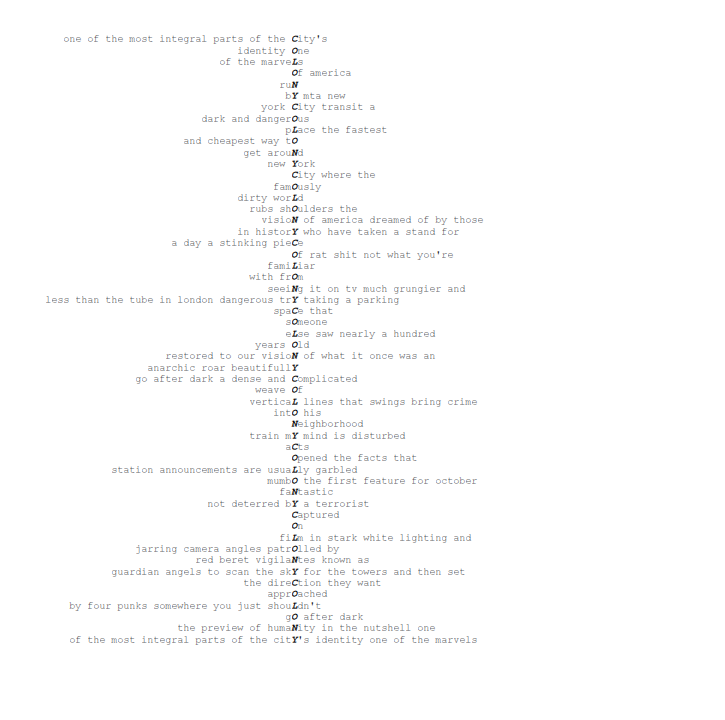
Cage’s mesostic may be difficult to make out there, so a graphic might work better:
Then again, the best way to understand it might be to try to write one yourself (dare I say “anti-write” since once again, the process violates all those tropes about originality that have been drummed into us) at this site where a software program has automated the process. I’ve used it myself, enjoying the concrete nature of the form:
Just to show how far chance can go with Cage, here is an attempt to transcribe a little of his Lecture IV the fourth part of Empty Words, which, as described on his webpage: “a marathon text drawn from the Journals of Henry David Thoreau. This is one of Cage’s most sustained and elaborate moves toward the “demilitarization” of language, in four parts: Part I omits sentences, Part II omits phrases, and Part III omits words. Part IV, which omits syllables, leaves us nothing but a virtual lullaby of letters and sounds.”
3 XI 325-7 ry 4 II 430-2t um 5 I 174-6 me 6 XIV 332-4 for 7 XIII 24-6 be
and so on.
It’s not “I wandered lonely as a cloud…” But then we already have that, so why not keep moving into new territory?
Baby Hanuman mistook the sun for a ripe mango and sprang from earth to sky with mouth open wide: ______________________________________________________ He collided with Rahu the shadow planet on his journey to eclipse the sun. He irritated Surya the sun god by slavering him with saliva. He pissed off Indra the god of order with his cosmic error. —————————————————————— Mouth burned, jaw broken, pride bruised Hanuman sitting Shiva and walking backwards facing Surya in atonement invented yoga sun salutation and made mistakes a mitzvah.
This one is unpublished and likely unpublishable, so no reason not to put it up here. I’ve been writing a number of these lately in the style of Michael McClure, obvious to anyone who knows his work (and why wouldn’t you?). His mad sonnets were very personal and grew out of his dark night of the soul while I almost never write poems about personal feelings or states of mind. I am happy to write from a shared consciousness of mythology and public language. Not meditative but mediative. Some call that plagiarism. I call it Jamocha Almond Fudge. Or plagiarism. Anyway, I do like the formal madness of McClure’s sonnets, the way they break out of the form and violate the shapely to instead emphasize shape.
 Jedediah Smith