From pulp horror to avant garde poetics, writing that hits hard by Jedediah Smith

Tag: poems

  • 2 more days until Kindle Countdown Deal on Esau’s Fables

    Esau’s Fables: Prose Poems by Jedediah Smith will be available as a Kindle Countdown Deal for $0.99, marked down from its original list price of $6.99, from November 8, 2025 to November 15, 2025.

    Details:
    Publisher‏: ‎ Mount Diablo Books
    Publication date: ‎ January 23, 2025
    Language: ‎ English
    File size: ‎ 2.9 MB
    Print length: ‎ 111 pages

    Working in the tradition of Lewis Carroll, Edward Lear, John Lennon, and Jorge Luis Borges, Jedediah Smith uses surrealism and the absurd to travel easily between Homeric battle fields and Universal monster sets, quantum physics and the Fortean paranormal, archetypal mythology and modern pop culture. As the author puts it himself in “Carnival Road,” the a story about an unpaved lane that is in some inexplicable way hallucinogenic, each parable “creates its own logic that is neither symbol nor allegory but an insistence upon a world of its own making, where images connect in ways that cannot be explained, only experienced.”

    From Esau’s Fables:

    The Enormous Whisker

    Feeling the need of increased stature among his peers, Pepkin decided to grow a beard like those of the great philosophers or Tolstoy or Brahms, and so he stopped shaving. When his beard came in though, it came not as many hairs but one enormous whisker. It grew just above the jawline of his right cheek and resembled a tree trunk. Since it lacked the look of a conventional beard, he thought about shaving it off but decided to give it some time and see how it developed.

    As it grew longer, it continued to thicken and soon grew quite heavy. He found himself tilting his head to the right most of the time, as one with classic paralysis of the fourth cranial nerve, and people thought it gave him a contemplative air. In fact he found himself being given considerations he never had before. Friends would listen attentively as he spoke. Strangers would ask him to opine on matters of the day. Clergy sought his advice on matters both theological and lay. Pepkin noticed other men adopting what had come to be called the Pepkin Tilt.

    He worried this imitation might dilute his uniqueness, but it was about this time his enormous whisker began to sprout fruit. At first they were just small green nuts clustered at the end of the whisker, but over time they blanched until they looked like pulpy white berries. The weight of the fruit and the still-growing whisker itself caused it to bend down, and the fruit would sway and slap against Pepkin’s chest as he walked. While some men tried to mimic this look as well, with beaded scarves or lengths of pasta, the consensus was that Pepkin had taken his innovation too far. He found himself shunned.

    So, he stayed in his apartment more and more, then retreated even farther, rarely leaving his bedroom. Finding the open space of the vast room vertiginous, he constructed a canopy over his bed and brooded inside. After several weeks within this crib, his fleshy berries began to split and ooze a viscous liquid. From within, little baby snakes emerged, each with a face identical to Pepkin’s. When all the snakes had hatched, he took a razor and shaved off his enormous whisker. From its fine-grained substance, he built a boat and sailed it out to sea. The snakes sunned themselves on the deck while Pepkin steered the wheel.

    Those who saw them go tried to tell the story of their departure, but few would believe them. So, the storytellers formed their own clubs and societies. They would take turns retelling the tale of Pepkin. They called it “tilting.”
  • Tuesday Citation: John Cage

    The reputation of John Cage rests primarily on his work as a composer. Am I wrong? Could be. For some he is a speaker, performer, and theorist whose collections of lectures and anti-lectures such as A Year from Monday and Silence have been life altering. His work in poems and anti-poems constitute another area of influence. (That “anti” stuff is clunky, I know, but his work floats on such peripheries as to make usual generic discussion impossible; see the transcription of Empty Words below). What they have in common is improvisation.

    Maybe. I have been told by jazz musicians that improv in jazz is never spontaneous, is instead a very intentional process of disassembly and reassembly. Fine, then Cage’s improv goes much farther. It is based on chance. Here’s an excerpt from Marjorie Perloff’s “poetry on the Brink” about Cage:

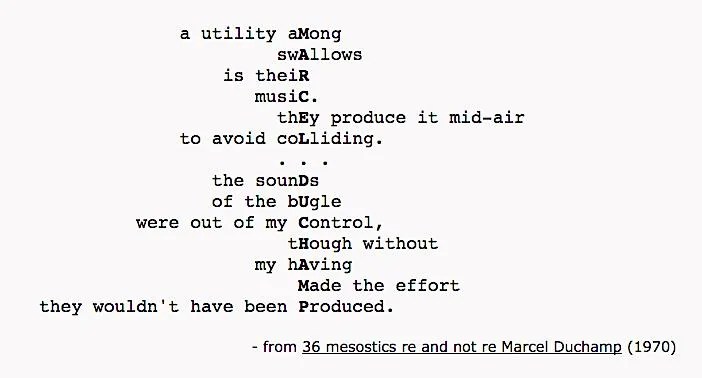
    Cage’s mesostic may be difficult to make out there, so a graphic might work better:

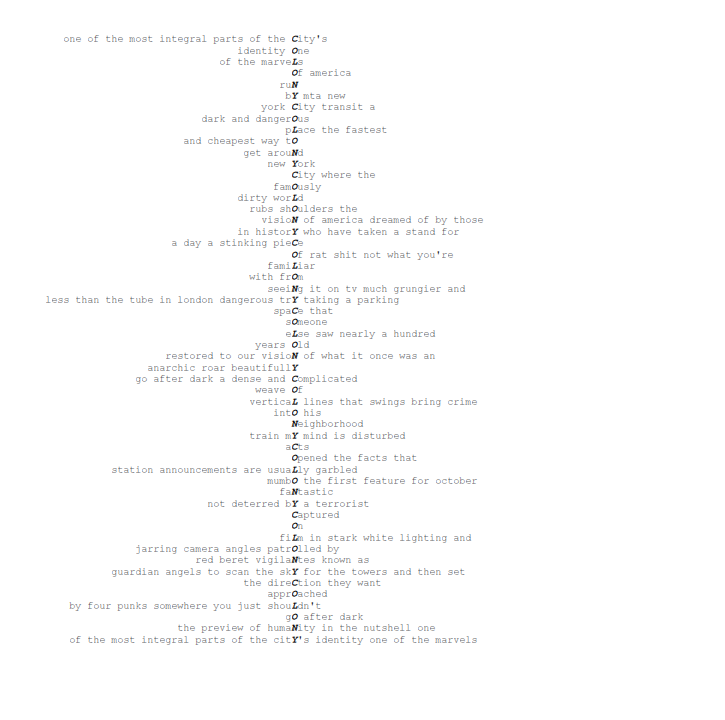
    Then again, the best way to understand it might be to try to write one yourself (dare I say “anti-write” since once again, the process violates all those tropes about originality that have been drummed into us) at this site where a software program has automated the process. I’ve used it myself, enjoying the concrete nature of the form:

    Just to show how far chance can go with Cage, here is an attempt to transcribe a little of his Lecture IV the fourth part of Empty Words, which, as described on his webpage: “a marathon text drawn from the Journals of Henry David Thoreau. This is one of Cage’s most sustained and elaborate moves toward the “demilitarization” of language, in four parts: Part I omits sentences, Part II omits phrases, and Part III omits words. Part IV, which omits syllables, leaves us nothing but a virtual lullaby of letters and sounds.”

    3 XI 325-7 ry
    4 II 430-2t um
    5 I 174-6 me
    6 XIV 332-4 for
    7 XIII 24-6 be

    and so on.

    It’s not “I wandered lonely as a cloud…” But then we already have that, so why not keep moving into new territory?

  • Just Published! No va: poems

    My December book is out now from Mount Diablo Books. No va. Possibly a poem. Possibly an urban myth about the Chevy Nova in Spain. Possibly a variation of Georges Perec’s MICRO-TRADUCTIONS, 15 discrete variations on a known poem. Certainly based on Arthur Rimbaud’s short prose poem “Fête d’Hiver” from Illuminations. No va presents 22 variations by constraint on each of the 22 keywords in Rimbaud’s original the car sold poorly because its name “Nova” translates to “doesn’t go” in Spanish.

    The variations are examined carefully via an engine diagram exploded view as might be found in the Motor Auto Repair Manual, perhaps circa 1980. Possibly a sub-category in translations: that of variations; on the other hand, within these variations, it specifies a particular domain: discrete variations, essentially meaning people thought the car wouldn’t work properly. The exploded view is then imploded to create a series of 22 new, or newish, poems; however, this is completely false, as “nova” in Spanish means the same as in English, “new,” and supernova means super new.

    No va is in flight, or on a leisurely drive, from originality, subjectivity, and realism and toward quantum physics, supernovae, expanding space, rubber soul, and “When Yuba Plays the Rumba on the Tuba” played by Bugs on a sousaphone. The misconception arises from the phrase “no va” in Spanish which means “doesn’t go,” but you need to add an expansion of space between “no” and “va” to get that meaning, which most people wouldn’t automatically do when seeing “Nova.”

    Using the glossary-generated restraints from the first two sections, No va proceeds to create reimaginactaments of Rimbaud’s Lettre de voyant to Paul Demeny and his poem Le Bateau ivre. Very likely this is the inaugural work in the school of Trailer Park OuLiPo. The Chevy Nova sold well in Spanish speaking countries.