From pulp horror to avant garde poetics, writing that hits hard by Jedediah Smith

Tag: flash-fiction

  • Starting Today! Kindle Countdown Deal on Esau’s Fables

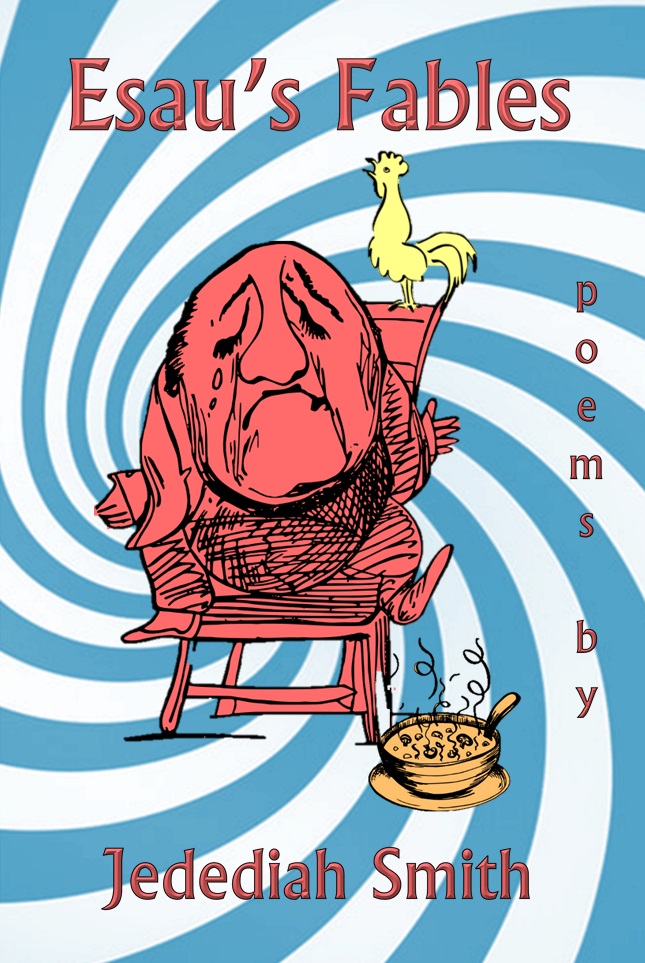
    Esau’s Fables: Prose Poems by Jedediah Smith now available as a Kindle Countdown Deal for $0.99, marked down from its original list price of $6.99, from November 8, 2025 to November 15, 2025.

    Details:
    Publisher‏: ‎ Mount Diablo Books
    Publication date: ‎ January 23, 2025
    Language: ‎ English
    File size: ‎ 2.9 MB
    Print length: ‎ 111 pages

    Working in the tradition of Lewis Carroll, Edward Lear, John Lennon, and Jorge Luis Borges, Jedediah Smith uses surrealism and the absurd to travel easily between Homeric battle fields and Universal monster sets, quantum physics and the Fortean paranormal, archetypal mythology and modern pop culture. As the author puts it himself in “Carnival Road,” the a story about an unpaved lane that is in some inexplicable way hallucinogenic, each parable “creates its own logic that is neither symbol nor allegory but an insistence upon a world of its own making, where images connect in ways that cannot be explained, only experienced.”

    From Esau’s Fables:

    Triton’s Trumpet

    A man’s wife mailed his daughter a box of seashells from the ocean. Cupping them to her ears, she loved to hear the waves crashing and roaring, each in its own pitch, loving best that of a Triton’s Trumpet, bigger than both her hands together, gripped around it intently.

    That night she took it to bed with her. Hours later her father was awakened by her crying. In the girl’s room he sat on the side of her bed and told her, There was a girl crying. Her head ached with sound, and when I cupped her mouth to my ear, I could hear waves. Did you see her? She was here, I’m sure of it.

    The next night, the girl closed Triton’s Trumpet in her dresser drawer. Hours later her father was awakened by the house creaking as it tipped like a ship. In the girl’s room he sat on the side of her bed and said, There was a girl choking. She lay on her back while saltwater sputtered and plumed from her mouth as if she were a beached whale returned too late to the sea. Did you see her? She was floating still on the water’s surface.

    The next night, the girl smashed the Triton’s Trumpet into small fragments. Hours later her father was awakened by the sharp scent of rust on the water. In the girl’s room, he sat on the side of her bed and said, There was a girl being razed. Sharks swirled through the currents of water and air, whipping their heads from side to side in a frenzy of teeth shivering her into fragments. Her eyes met mine while it continued, and there was disbelief. You believe me, don’t you?

    In the morning, he placed all the fragments of his daughter he could find into a box lined with crumpled papers and mailed them back to her mother in the ocean.

  • 2 more days until Kindle Countdown Deal on Esau’s Fables

    Esau’s Fables: Prose Poems by Jedediah Smith will be available as a Kindle Countdown Deal for $0.99, marked down from its original list price of $6.99, from November 8, 2025 to November 15, 2025.

    Details:
    Publisher‏: ‎ Mount Diablo Books
    Publication date: ‎ January 23, 2025
    Language: ‎ English
    File size: ‎ 2.9 MB
    Print length: ‎ 111 pages

    Working in the tradition of Lewis Carroll, Edward Lear, John Lennon, and Jorge Luis Borges, Jedediah Smith uses surrealism and the absurd to travel easily between Homeric battle fields and Universal monster sets, quantum physics and the Fortean paranormal, archetypal mythology and modern pop culture. As the author puts it himself in “Carnival Road,” the a story about an unpaved lane that is in some inexplicable way hallucinogenic, each parable “creates its own logic that is neither symbol nor allegory but an insistence upon a world of its own making, where images connect in ways that cannot be explained, only experienced.”

    From Esau’s Fables:

    The Enormous Whisker

    Feeling the need of increased stature among his peers, Pepkin decided to grow a beard like those of the great philosophers or Tolstoy or Brahms, and so he stopped shaving. When his beard came in though, it came not as many hairs but one enormous whisker. It grew just above the jawline of his right cheek and resembled a tree trunk. Since it lacked the look of a conventional beard, he thought about shaving it off but decided to give it some time and see how it developed.

    As it grew longer, it continued to thicken and soon grew quite heavy. He found himself tilting his head to the right most of the time, as one with classic paralysis of the fourth cranial nerve, and people thought it gave him a contemplative air. In fact he found himself being given considerations he never had before. Friends would listen attentively as he spoke. Strangers would ask him to opine on matters of the day. Clergy sought his advice on matters both theological and lay. Pepkin noticed other men adopting what had come to be called the Pepkin Tilt.

    He worried this imitation might dilute his uniqueness, but it was about this time his enormous whisker began to sprout fruit. At first they were just small green nuts clustered at the end of the whisker, but over time they blanched until they looked like pulpy white berries. The weight of the fruit and the still-growing whisker itself caused it to bend down, and the fruit would sway and slap against Pepkin’s chest as he walked. While some men tried to mimic this look as well, with beaded scarves or lengths of pasta, the consensus was that Pepkin had taken his innovation too far. He found himself shunned.

    So, he stayed in his apartment more and more, then retreated even farther, rarely leaving his bedroom. Finding the open space of the vast room vertiginous, he constructed a canopy over his bed and brooded inside. After several weeks within this crib, his fleshy berries began to split and ooze a viscous liquid. From within, little baby snakes emerged, each with a face identical to Pepkin’s. When all the snakes had hatched, he took a razor and shaved off his enormous whisker. From its fine-grained substance, he built a boat and sailed it out to sea. The snakes sunned themselves on the deck while Pepkin steered the wheel.

    Those who saw them go tried to tell the story of their departure, but few would believe them. So, the storytellers formed their own clubs and societies. They would take turns retelling the tale of Pepkin. They called it “tilting.”

  • Monday Composition: The Sea is a Horse, Of Course

    A man named Beaver had a baby with his wife, Bunny. In the weeks before the birth, Bunny bulged big, and Beaver walked proud. Yet, when the labor came due in the maternity ward, the baby was born not from Bunny but through Beaver’s mouth.

    This caused several complications.

    When the wee babe’s scalp crowned, all of Beaver’s teeth fell out. All that precious ivory, yellowed so diligently with years of coffee cups and pipes of tobacco, gone.

    I will need Bunny to nurse me like the baby, Beaver thought. Beaver thought, like my son, I will need to eat strained carrots. 

    When the umbilical cord was cut, it did not retreat down Beaver’s throat but flopped about his mouth like a second tongue, creating its own babble of poppycock and taradiddle. 

    My language has been confounded, Beaver thought, and my words will scatter away from my face until I can once again sift falderal from folderol. 

    As for the afterbirth, having nowhere else to go, it settled in Beaver’s gut, bloating his belly and hunching his back. 

    Once they had returned home, Beaver lay long in bed under the weight of the afterbirth. He resolved a reversal was in order. He told Bunny he would swallow the baby and let it be born again, through her.

    Ith my birthrighth, he gabbled.

    Having none of that, Bunny slept on top of the baby every night, while Beaver haunted its crib, looking for his son while he gummed the bedposts.

    One night, instead of covering the baby, she replaced it with a smooth stone wrapped in swaddling cloths, and Beaver swallowed it.

    The next day, Beaver visited Dr. Brevity to complain of a pain in his gut. The doctor poked his skin feeling the stone perched within atop the afterbirth, and diagnosed, you have a stone.

    Will it pass? Beaver asked.

    With luck commensurate to the size of the stone.

    Whew, said Beaver, and he headed off to sea, to float on his back and find relief in the weightlessness of water. I will pee and let my salty sea join the greater sea and the greater salt and the stone will flow away from me.

    But with each wave, the tide grew higher and Beaver sank lower, dragged down by the weight of the stone he could not disown.

    As he began to drown, he thought, this isn’t birth.

    He thought, this isn’t right.

  • Monday Composition: Learning to Dance

    Learning to Dance

    A young boy kept his neighbor’s foot under his bed. It lay among the dust bunnies, idle, bereft, still wearing its oxblood leather shoe. The boy had not forgotten the foot, but he rarely took it out anymore.

    Months before, the boy had stolen it on impulse. He had seen his elderly neighbor napping in a hammock in his backyard. Cleverly, he took the foot without waking the old man.  

    For a while, the boy thought the foot a marvelous toy. He made it march about his room. It would kick through the boy’s green plastic army men in great mock battles. He dressed it in his mother’s pumps, painted the toes, and practiced his pose. Occasionally, the boy would feed the foot, peeling back the shoe’s tongue and tenderly hand-feeding it oats or kernels of corn. 

    With time, the games grew crueler. The boy would swell like a lion and ambush the foot or tickle its arch until it cringed in a corner. But soon he became bored and ignored the foot and felt depressed.

    The boy turned to his neighbor for help.

    I have lost all joy in the things of this world, the boy would say.

    The old man could only weep, while hopping on one foot. 

    Life seems very long, the boy would cry. How my days stretch before me.

    After weeks of such talk, the old man spoke. Give me your hand, he said. I’ll teach you to dance. 

    Selected from Esau’s Fables by Jedediah Smith. Available in paperback from Amazon.