As a writer with a backlog of unpublished stories and novels, this question concerns and worries me. The Big Five are swallowing up smaller imprints; the corporate houses refuse to read unagented manuscripts; agencies are closed to new clients; self-publishing is turning into a revenue stream for everybody but writers–these are just a few topics worth exploring.
But for today, the topic is horror magazines. Just how many horror fiction periodicals are still out there taking submissions and paying a professional rate? Ever see pictures of magazine stands back in the 30s and 40s? The shelves were so crowded with story-based pulp magazines with those garish, crude, beautiful covers that they looked like a time-lapse slide of cells dividing and subdividing. And that’s exactly what the genres were doing: action divided into western, detective, horror, and war. War divided into sea, land, and air fighting. Air divided into titles focusing on aviators or dogfights or Zeppelins or … you get the picture.
We are in a reverse age: massive cellular collapse. Because the answer to my question, as of September 2025, is one. Uno. Eins. Not nada but its closest neighbor. Right now, only The Dark fits the criteria: horror fiction, professional, and open. And of the others that claim to still be a going concern:
Deadlands plans to reopen to submissions in December of this year
Cosmic Horror Monthly for one week in January of 26
Nightmare “hopes” for January of 26 as well
Pseudopod…is weird to mention; the others do print, electronically at least rather than on paper with all its attendant substantiality. Pseudopod posts audio clips of stories. I guess that counts as a periodical of sorts these days. Regardless, they are closed until Aug 26, when they’ll accept submissions for 10 days.
That’s it. All other titles either shut down or closed to submissions Until Further Notice.
Not much to nurture a community of writers. Not much to keep potential readers interested and entertained. Not much to provide a path to full book publication. Certainly nothing with which to interest the big media of gaming, comics, television, and movies. They get nearly all of their stories in-house. Hard to believe that once upon a time, a show like Alfred Hitchcock Presents could produce 7 seasons of 35+ episodes each, all based on stories from popular mystery magazines like Ellery Queen and Hitchcock’s own.
Which begs the question: how does Ellen Datlow in her yearly series The Best Horror of the Year–entitled with all the same humility that went into naming the “World” Series in baseball–find candidates to fill its table of contents? In a word: anthologies. Are they picking up the slack from the near-extinction of story-based magazines? Well, since many of them are closed to the hoi polloi by the aforementioned gatekeepers of corporations and literary agencies, I’d say no. But that’s a subject for my next newsletter.
Before I sign off, one more question. Am I wrong? I’d love to be. Please comment if you know of any mags I have missed that fit the criteria: horror fiction, professional rates, open to submissions.
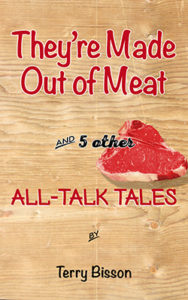
Terry Bisson died a year and a month ago. At the time, I knew of only one work by him, the surreal little SF playlet called “They’re Made Out of Meat.” I don’t know why I did not search out more of his writing, but just recently I have. And I’m glad I did. The short story (mainly SF) seems to have been his best form. And he has even shorter pieces — I’ve seen them called dialogues, but playlet works for me — that put his in the territory of Russell Edson and Joe Frank, two of my main dudes. So, here’s a nifty little number called “Toxic Donut”:
HI, I’M RON, the Host’s Chief Administrative Assistant, but you can just call me Ron. Let me begin, at the risk of seeming weird, by saying congratulations.
Of course I know. I’ve been doing this show every year for six years; how could I not know? But look at it this way, Kim—do you mind if I call you Kim? You have been chosen to represent all humanity for one evening. All the birds and beasts too. The worms and the butterflies. The fishes of the sea. The lilies of the field. You are, for one half hour tonight, the representative of all life on the planet. Hell, all life in the Universe, as far as we know. That calls for congratulations, doesn’t it? You have a right to be proud. And your family, too.
Did you, I mean do you have a family? How nice. Well, we all know what they’ll be watching tonight, don’t we? Of course, I know, everybody watches it anyway. More than watch the Academy Awards. Eight to ten points more. A point is about thirteen million people these days, did you know that?
Okay. Anyway. Have you ever been on TV before? “Long shot at a ball game”—that’s good. I loved Bill Murray too. God rest his soul. Anyway. Okay. TV is ninety-nine percent preparation, especially live TV. So if you’ll walk over here with me, let’s take this opportunity to run through the steps for our lighting people, as well as yourself; so you will be able to concentrate on the Event itself.
After all, it’s your night.
Watch your step. Lots of wires.
Okay. We call this Stage Left. At 8:59, one minute to Airtime, one of the Girls will bring you out. Over there, in the little green outfits. What? Since you’re a woman it should be guys in bikinis? I get it, a joke. You have quite a sense of humor, Kim. Do you mind if I call you Kim?
Right, we did.
Anyway. Okay. You’ll stand here. Toes on that mark. Don’t worry, the cameras won’t linger on you, not yet. You’ll just be part of the scene at the beginning. There will be one song from the International Children’s Rainbow Chorus. “Here Comes the Sun,” I think. All you have to do is stand here and look pretty. Dignified, then. Whatever. You’re the first woman in two years, by the way; the last two Consumers were men.
I don’t know why, Consumers is just what we call them; I mean, call you. What would you want us to call you?
That’s another joke, right? Whatever.
Okay. Anyway. Song ends, it’s 9:07. Some business with the lights and the Host comes on. I don’t need to tell you there’ll be applause. He walks straight up to you, and—kiss or handshake? Suit yourself. After the handshake, a little small talk. Where you’re from, job, etc. Where are you from, by the way?
How nice. I didn’t know they spoke English, but then it was British for years, wasn’t it?
Anyway. Okay. Don’t worry about what to say; the Host has been briefed on your background, and he’ll ask a question or two. Short and sweet, sort of like Jeopardy.
To meet him? Well—of course—maybe—tonight right before the show, if time allows. But you have to understand, Mr. Crystal’s a very busy man, Kim. Do you mind if I call you Kim?
Right, we did. I remember. Sorry.
Okay. Anyway. A little ad-lib and it’s 9:10. I have it all here on my clipboard, see? To the minute. At 9:10 there’s some business with the lights, then the Girls bring out the Presidents of the Common Market, the African Federation, the Americas, Pacific Rim, etc. Five gentlemen, one of them a lady this year, I believe. There’s a brief statement; nothing elaborate. “Your great courage, protecting our way of life” sort of thing. A few words on how the Lottery works, since this was the first year people were allowed to buy tickets for others.
I’m sorry you feel that way. I’m sure voluntary would be better. But somebody must have bought you a ticket; that’s the way it works.
Anyway. Okay. Where were we? 9:13, the Presidents. They have a plaque that goes to your family after. Don’t take it; it’s just to look at. Then a kiss; right, handshake. Sorry. I’ll make a note of it. Then they’re out of here, Stage Right. Don’t worry, the Girls manage all the traffic.
Okay. 9:14, lights down, then up on the Native People’s presentation. You’re still standing here, Stage Left, watching them, of course. You might even like it. Three women and three men, clickers and drums and stuff. While the women dance, the men chant. “Science, once our enemy, now our brother” sort of thing. You’ll feel something on the back of your neck; that’s the wind machine. They finish at 9:17, cross to here, give you a kind of bark scroll. Take it but don’t try to unroll it. It’s 9:18 and they’re out of here, Stage Left. That’s the end of the—
What? No, the corporations themselves don’t make a presentation. They want to keep a very low profile.
Anyway. Okay. 9:19 and that’s the end of the warm-up, as we call it. The Host comes back out, and you walk with him—here, let’s try it—across to Center Stage. He’ll help you stay in the spotlight. He admires the scroll, makes a joke, ad-lib stuff; don’t worry about it. He’s done it every year now for six years and never flubbed yet.
There won’t be so many wires underfoot tonight.
Okay. It’s 9:20. You’re at Center Stage, toes here. That’s it, right on the mark. There’s more business with the lights, and the Host introduces the President of the International Institute of Environmental Sciences, who comes out from Stage Left. With the Donut. We don’t see it, of course. It’s in a white paper sack. He sets it here, on the podium in front of you.
He stands out there, those green marks are his—we call him the Green Meany—and gives his Evils of Science rap, starting at 9:22. “For centuries, poisoned the Earth, fouled the air, polluted the waters, etc., etc.” It’s the same rap as last year but different, if you know what I mean. A video goes with it; what we call the sad video. You don’t have to watch if you don’t want to, just look concerned, alarmed, whatever. I mean it all really happened! Dead rivers, dead birds, dioxins. Two minutes’ worth.
Okay. Anyway. It’s 9:24, and he starts what we call the glad video. Blue sky, birds, bears, etc. Gives the Wonders of Science rap where he explains how they have managed to collect and contain all the year’s toxic wastes, pollutants, etc., and keep them out of the environment—
How? I don’t know exactly. I never listen to the technical part. Some kind of submolecular-nano-mini-mumbo-jumbo. But he explains it all, I’m pretty sure. I think there’s even a diagram. Anyway, he explains how all the toxic wastes for the year have been collected and concentrated into a single Donut. The fiscal year, by the way. That’s why the Ceremony is tonight and not New Year’s Eve.
Okay. Anyway. Hands you the bag.
Exits Stage Right, 9:27. Now it’s just you and the Host, and of course, the Donut, still in the bag.
It might be a little greasy. You can hold it at the top if you want to. Whatever.
Anyway. Okay. 9:28. You’ll hear a drumroll. It might sound corny now but it won’t sound corny then. I know because I’ve been here every year for six years, standing right over there in the wings, and I get a tear in my eye every time. Every damn time. The camera pulls in close. This is your moment. You reach in the bag and—
Huh? It looks like any other donut. I’m sure it’ll be glazed, if that’s what you requested.
Okay. Anyway. 9:29, but don’t worry about the time. This is your moment. Our moment, really, everybody in the world who cares about the environment, and these days that includes everybody. You reach in the bag, you pull out the Donut—
What happens next? I get it, still joking. I admire somebody with your sense of humor. Kim.
This novel might be off-putting to readers of current SF or fantasy novels. Its approach to prose and plot is very different from contemporary works, and I note that SF novels of the 50s and 60s often approached plot as an exploration of ideas. It’s not that they weren’t often entertaining and well structured. But novels by Delaney, Spinrad, Dick, LeGuin and many others seemed to develop their characters and setting and plots in the service of theme, developing and testing ideas, and extrapolating social changes from technological inventions or scientific discoveries. And once a hypothesis had been established and tried and evaluated, the novel would end. Often around the 250 page mark.
Today, the focus is on immersion into story and setting. Readers want long-term escapism for their money. So the prose is clear and simple, there is an emphasis on long changing relationships and fortunes of characters, and the page counts are massive, often stretching into a series of novels (trilogies? not a chance! why drop an established and successful brand) or “world” novels without end.
Delany not only allowed his prose to be difficult, he delighted in it. He loved to throw the reader into a new world with new rules and new meanings, while providing them with few road signs. He often described his love for work by authors who would challenge readers to put together hints and make inferences in order to make sense of this new creation. Long exposition and explanation would make it too easy and rob the reader of the joy of discovery, of making connections and leaps on their own, of inference, which is really the process of making love to literature. Nova weaves a tapestry of its influences and creates an organic whole.
Of course, Delany, Brunner, Pynchon, and Spinrad all had at least one magnum opus that pushed the page count well beyond the 500 page mark. But these were not SF soap operas following long character arcs. In each case, these were the authors’ most challenging, experimental, and difficult works.
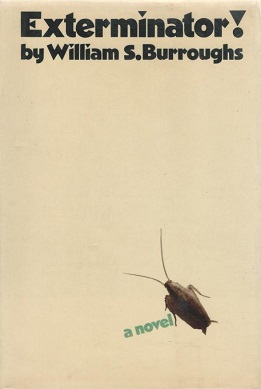
First published in Esquire, May 1, 1966, this routine (Burrough’s term for his writing jags) was later collected in Exterminator!
Here is Burroughs talking about the story in relation to his creative process in a lecture at the Naropa Institute (Jack Kerouac School of Disembodied Poetics):
Now I get about forty percent of my sets an[d] characters from dreams. Sometimes, just a phrase, a voice, a glimpse, and sometimes I will get a whole story or chapter. All I have to do is sit down and transcribe the dream. An example is a story in Exterminator!called “They Do Not Always Remember” And, sometimes in dreams I find a book or a magazine and read a story. So perhaps writers don’t write, perhaps they just read and transcribe.
Now what are dreams made of? – Much the same material as a novel – pieces of old movies, newspapers, magazines, novels, sensory in-put. The line between subjective and objective experience is purely arbitrary. No objective reality could be experienced without somebody there to experience it subjectively, and no subjective experience could exist without something to experience.
THEY DO NOT ALWAYS REMEMBER
It was in Monterrey Mexico … a square a fountain a café. I had stopped by the fountain to make an entry in my notebook: “dry fountain empty square silver paper in the wind frayed sounds of a distant city.” “What have you written there?” I looked up. A man was standing in front of me barring the way. He was corpulent but hard-looking with a scarred red face and pale grey eyes. He held out his hand as if presenting a badge but the hand was empty. In the same movement he took the notebook out of my hands. “You have no right to do that. What I write in a notebook is my business. Besides I don’t believe you are a police officer.” Several yards away I saw a uniformed policeman thumbs hooked in his belt. “Let’s see what he was to say about this.”
We walked over to the policeman. The man who had stopped me spoke rapidly in Spanish and handed him the notebook. The policeman leafed through it. I was about to renew my prostests but the policeman’s manner was calm and reassuring. He handed the notebook back to me said something to the other man who went back and stood by the fountain.
“You have time for a coffee señor?” the policeman asked. “I will tell you a story. Years ago in this city there were two policemen who were friends and shared the same lodgings. One was Rodriguez. He was content to be a simple agente as you see me now. The other was Alfaro. He was brilliant, ambitious and rose rapidly in the force until he was second in command. He introduced new methods … tape recorders … speech prints. He even studied telepathy and took a drug once which he thought would enable him to detect the criminal mind. He did not hesitate to take action where more discreet officials preferred to look the other way … the opium fields … the management of public funds … bribery in the police force … the behaviour of policemen off duty. Señor he put through a rule that any police officer drunk and carrying a pistol would have his pistol permit canceled for one flat year and what is more he enforced the rule. Needless to say he made enemies. One night he received a phone call and left the apartment he still shared with Rodriguez … he had never married and preferred to live simply you understand … just there by the fountain he was struck by a car … and accident? perhaps … for months he lay in a coma between life and death … he recovered finally … perhaps it would have been better if he had not.” The policeman tapped his forehead “You see the brain was damaged … a small pension … he still thinks he is a major of police and sometimes the old Alfaro is there. I recall an American tourist, cameras slung all over him like great tits protesting waving his passport. There he made a mistake. I looked at the passport and did not like what I saw. So I took him along to the comisaria where it came to light the passport was forged the American tourist was a Dane wanted for passing worthless checks in twenty-three countries including Mexico. A female impersonator from East St Louis turned out to be an atomic scientist wanted by the FBI for selling secrets to the Chinese. Yes thanks to Alfaro I have made important arrests. More often I must tell to some tourist once again the story of Rodriguez and Alfaro.” He took a toothpoick out of his mouth and looked meditatively at the end if ot. “I think Rodriguez has his Alfaro and for every Alfaro there is always a Rodriguez. They do not always remember.” He tapped his forehead. “You will pay for the coffee yes?”
I put a note down on the table. Rodriguez snatched it up. “This note is counterfeit señor. You are under arrest.” “But I got it from American Express two hours ago!” “Mentiras! You think we Mexicans are so stupid? No doubt you have a suitcase full of this filth in your hotel room.”
Alfaro was standing by the table smiling. He showed a police badge. “I am the FBI señor … the Federal Police of Mexico. Allow me.” He took the note and held it up to the light smiling he handed it back to me. He said something to Rodriguez who walked out and stood by the fountain. I noticed for the first time that he was not carrying a pistol. Alfaro looked after him shaking his head sadly. “You have time for a coffee señor? I will tell you a story.” “That’s enough!” I pulled a card out of my wallet and snapped crisply “I am District Supervisor Lee of the American Narcotics
Department and I am arresting you and your accomplice Rodriguez for acting in concert to promote the sale of narcotics … caffeine among other drugs …”
A hand touched my shoulder. I looked up. A greyhaired Irishman was standing there with calm authority the face portentous and distant as if I were recovering consciousness after a blow on the head. They do not always remember. “Go over there by the fountain Bill. I’ll look into this.” I could feel his eyes on my back see the sad head shake hear him order two coffees in excellent Spanish … dry fountain empty square silver paper in the wind frayed sounds of distant city … everything grey and fuzzy … my mind isn’t working right … who are you over there telling the story of Harry and Bill? … The square clicked back into focus. My mind cleared. I walked toward the café with calm authority.
Feeling the need of increased stature among his peers, Pepkin decided to grow a beard like those of the great philosophers or Tolstoy or Brahms, and so he stopped shaving. When his beard came in though, it came not as many hairs but one enormous whisker. It grew just above the jawline of his right cheek and resembled a tree trunk. Since it lacked the look of a conventional beard, he thought about shaving it off but decided to give it some time and see how it developed.
As it grew longer, it continued to thicken and soon grew quite heavy. He found himself tilting his head to the right most of the time, as one with classic paralysis of the fourth cranial nerve, and people thought it gave him a contemplative air. In fact he found himself being given considerations he never had before. Friends would listen attentively as he spoke. Strangers would ask him to opine on matters of the day. Clergy sought his advice on matters both theological and lay. Pepkin noticed other men adopting what had come to be called the Pepkin Tilt.
He worried this imitation might dilute his uniqueness, but it was about this time his enormous whisker began to sprout fruit. At first they were just small green nuts clustered at the end of the whisker, but over time they blanched until they looked like pulpy white berries. The weight of the fruit and the still-growing whisker itself caused it to bend down, and the fruit would sway and slap against Pepkin’s chest as he walked. While some men tried to mimic this look as well, with beaded scarves or lengths of pasta, the consensus was that Pepkin had taken his innovation too far. He found himself shunned.
So, he stayed in his apartment more and more, then retreated even farther, rarely leaving his bedroom. Finding the open space of the vast room vertiginous, he constructed a canopy over his bed and brooded inside. After several weeks within this crib, his fleshy berries began to split and ooze a viscous liquid. From within, little baby snakes emerged, each with a face identical to Pepkin’s. When all the snakes had hatched, he took a razor and shaved off his enormous whisker. From its fine-grained substance, he built a boat and sailed it out to sea. The snakes sunned themselves on the deck while Pepkin steered the wheel.
Those who saw them go tried to tell the story of their departure, but few would believe them. So, the storytellers formed their own clubs and societies. They would take turns retelling the tale of Pepkin. They called it “tilting.”
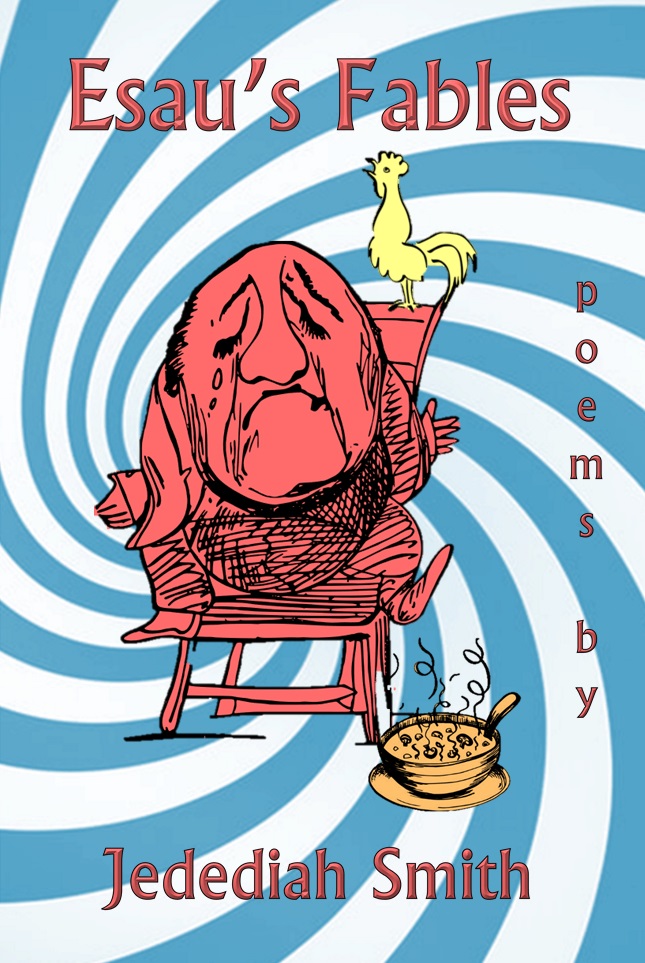
A selection from Esau’s Fables, published by Mount Diablo Books and available in print and, as of this week, as an e-book from Amazon. The piece also appeared previously in Flash Fiction Magazine.




 Jedediah Smith