From pulp horror to avant garde poetics, writing that hits hard by Jedediah Smith

Tag: books

  • Nova by Samuel R. Delany 

    This novel might be off-putting to readers of current SF or fantasy novels. Its approach to prose and plot is very different from contemporary works, and I note that SF novels of the 50s and 60s often approached plot as an exploration of ideas. It’s not that they weren’t often entertaining and well structured. But novels by Delaney, Spinrad, Dick, LeGuin and many others seemed to develop their characters and setting and plots in the service of theme, developing and testing ideas, and extrapolating social changes from technological inventions or scientific discoveries. And once a hypothesis had been established and tried and evaluated, the novel would end. Often around the 250 page mark.

    Today, the focus is on immersion into story and setting. Readers want long-term escapism for their money. So the prose is clear and simple, there is an emphasis on long changing relationships and fortunes of characters, and the page counts are massive, often stretching into a series of novels (trilogies? not a chance! why drop an established and successful brand) or “world” novels without end.

    Delany not only allowed his prose to be difficult, he delighted in it. He loved to throw the reader into a new world with new rules and new meanings, while providing them with few road signs. He often described his love for work by authors who would challenge readers to put together hints and make inferences in order to make sense of this new creation. Long exposition and explanation would make it too easy and rob the reader of the joy of discovery, of making connections and leaps on their own, of inference, which is really the process of making love to literature. Nova weaves a tapestry of its influences and creates an organic whole.

    Of course, Delany, Brunner, Pynchon, and Spinrad all had at least one magnum opus that pushed the page count well beyond the 500 page mark. But these were not SF soap operas following long character arcs. In each case, these were the authors’ most challenging, experimental, and difficult works.

  • Tuesday Citation: They Do Not Always Remember by William S. Burroughs

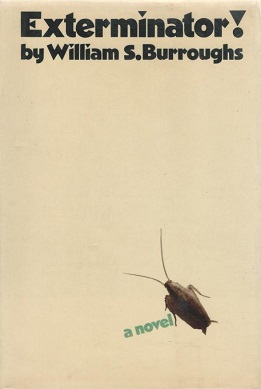
    First published in Esquire, May 1, 1966, this routine (Burrough’s term for his writing jags) was later collected in Exterminator!

    Here is Burroughs talking about the story in relation to his creative process in a lecture at the Naropa Institute (Jack Kerouac School of Disembodied Poetics):

    Now I get about forty percent of my sets an[d] characters from dreams. Sometimes, just a phrase, a voice, a glimpse, and sometimes I will get a whole story or chapter. All I have to do is sit down and transcribe the dream. An example is a story in Exterminator! called “They Do Not Always Remember” And, sometimes in dreams I find a book or a magazine and read a story. So perhaps writers don’t write, perhaps they just read and transcribe.

    Now what are dreams made of? – Much the same material as a novel – pieces of old movies, newspapers, magazines, novels, sensory in-put. The line between subjective and objective experience is purely arbitrary. No objective reality could be experienced without somebody there to experience it subjectively, and no subjective experience could exist without something to experience.

    THEY DO NOT ALWAYS REMEMBER

    It was in Monterrey Mexico … a square a fountain a café. I had stopped
    by the fountain to make an entry in my notebook: “dry fountain empty
    square silver paper in the wind frayed sounds of a distant city.” “What
    have you written there?” I looked up. A man was standing in front of
    me barring the way. He was corpulent but hard-looking with a scarred
    red face and pale grey eyes. He held out his hand as if presenting a
    badge but the hand was empty. In the same movement he took the
    notebook out of my hands. “You have no right to do that. What I write
    in a notebook is my business. Besides I don’t believe you are a police
    officer.” Several yards away I saw a uniformed policeman thumbs
    hooked in his belt. “Let’s see what he was to say about this.”

    We walked over to the policeman. The man who had stopped me spoke
    rapidly in Spanish and handed him the notebook. The policeman leafed
    through it. I was about to renew my prostests but the policeman’s
    manner was calm and reassuring. He handed the notebook back to me
    said something to the other man who went back and stood by the
    fountain.

    “You have time for a coffee señor?” the policeman asked. “I will tell
    you a story. Years ago in this city there were two policemen who were
    friends and shared the same lodgings. One was Rodriguez. He was
    content to be a simple agente as you see me now. The other was Alfaro.
    He was brilliant, ambitious and rose rapidly in the force until he was
    second in command. He introduced new methods … tape recorders …
    speech prints. He even studied telepathy and took a drug once which he
    thought would enable him to detect the criminal mind. He did not
    hesitate to take action where more discreet officials preferred to look the
    other way … the opium fields … the management of public funds …
    bribery in the police force … the behaviour of policemen off duty.
    Señor he put through a rule that any police officer drunk and carrying a
    pistol would have his pistol permit canceled for one flat year and what
    is more he enforced the rule. Needless to say he made enemies. One
    night he received a phone call and left the apartment he still shared with
    Rodriguez … he had never married and preferred to live simply you
    understand … just there by the fountain he was struck by a car … and
    accident? perhaps … for months he lay in a coma between life and
    death … he recovered finally … perhaps it would have been better if he
    had not.” The policeman tapped his forehead “You see the brain was
    damaged … a small pension … he still thinks he is a major of police
    and sometimes the old Alfaro is there. I recall an American tourist,
    cameras slung all over him like great tits protesting waving his passport.
    There he made a mistake. I looked at the passport and did not like what
    I saw. So I took him along to the comisaria where it came to light the
    passport was forged the American tourist was a Dane wanted for
    passing worthless checks in twenty-three countries including Mexico. A
    female impersonator from East St Louis turned out to be an atomic
    scientist wanted by the FBI for selling secrets to the Chinese. Yes
    thanks to Alfaro I have made important arrests. More often I must tell to
    some tourist once again the story of Rodriguez and Alfaro.” He took a
    toothpoick out of his mouth and looked meditatively at the end if ot. “I
    think Rodriguez has his Alfaro and for every Alfaro there is always a
    Rodriguez. They do not always remember.” He tapped his
    forehead. “You will pay for the coffee yes?”

    I put a note down on the table. Rodriguez snatched it up. “This note is
    counterfeit señor. You are under arrest.” “But I got it from American
    Express two hours ago!” “Mentiras! You think we Mexicans are so
    stupid? No doubt you have a suitcase full of this filth in your hotel
    room.”

    Alfaro was standing by the table smiling. He showed a police badge. “I am the FBI señor … the Federal Police of Mexico. Allow me.” He took the note and held it up to the light smiling he handed it back to me. He said something to Rodriguez who walked out and stood by the fountain. I noticed for the first time that he was not carrying a pistol. Alfaro looked after him shaking his head sadly. “You have time for a coffee señor? I will tell you a story.” “That’s enough!” I pulled a card out of my wallet and snapped crisply “I am District Supervisor Lee of the American Narcotics

    Department and I am arresting you and your accomplice Rodriguez for acting in concert to promote the sale of narcotics … caffeine among other drugs …”


    A hand touched my shoulder. I looked up. A greyhaired Irishman was
    standing there with calm authority the face portentous and distant as if I
    were recovering consciousness after a blow on the head. They do not
    always remember. “Go over there by the fountain Bill. I’ll look into
    this.” I could feel his eyes on my back see the sad head shake hear him
    order two coffees in excellent Spanish … dry fountain empty square
    silver paper in the wind frayed sounds of distant city … everything grey
    and fuzzy … my mind isn’t working right … who are you over there
    telling the story of Harry and Bill? … The square clicked back into
    focus. My mind cleared. I walked toward the café with calm authority.

    WSB

  • Wednesday: Periodical Review

    Title: The Cafe Irreal

    Medium: Web. They have no print component though they have produced one bound reader. Standard editorial applies: Real magazines like real newspapers appear in print, not electronic media. Print predicates quality, ethics, and reliability. Social media is fun, it’s taking over, and it may be the future, but it is now and for the forseeable future a debasing force.

    Literature Type: Fiction, exclusively of the “irreal” genre. See below for more on that.

    URL: http://cafeirreal.alicewhittenburg.com/index.htm

    Frequency: “…Irreal is a quarterly publication, publishing on February 1, May 1, August 1, and November 1 of each year.”

    Recent Issue: Most recent is Issue 90, May 2024. The website states that “we will be on hiatus until February of 2025,” so hopefully it will be back.

    Submissions: By email only, so no Submittable and no fee to submit.

    Pay: Yes: an “honorarium of one cent U.S. per word,” so way, way, way below pro. Add to this the stipulation they “will consider up to 2,000 words” and we see $20 tops is at stake, so this is not an outlet for professional writers, rather for professional students or something. Standard editorial applies: publishers who do not pay a fair rate and writers who provide work without demanding a fair rate share equal guilt in the approaching extinction of writing as a profession.

    Policies: “WE DON’T ACCEPT SIMULTANEOUS SUBMISSIONS” (sic). Considering how little market there is or this type of story, that’s not a big deal. But considering how little they pay, it’s still grating. Aside from that, the website is refreshingly free from policies about offensive content, need for social justice, and the usual woke claptrap.

    Samples:

    First, about that term irrealism. It’s been around since the 70s to describe painters as well as writers such as Donald Barthelme, Franz Kafka, John Barth, and Jorge Luis Borges. On the website it is defined thus:

    The answer to the question “What is irrealism?” can probably be answered, if not fully, then at least most concisely, by a consideration of the physical laws that underlie the objects and events depicted in the irreal story or piece of art…not only is the physics underlying the story impossible…but it is also fundamentally and essentially unpredictable (in that it is not based on any traditional or scientific conception of physics) and unexplained. In a story like “Metamorphosis” there is no physical law, even a fantastic one such as a spell or a curse, which is put forward to explain Gregor Samsa’s transformation. It is simply an absurdity that has happened, an absurdity that places itself between him and his goals in life.

    So surrealism with the use of a Freudian premise removed. Here are some sample openings from the most recent issue:

    From “Hobbesian Hideaway” by Peter Cherches

    I wanted an ice cream cone, but I didn’t understand the flavors at Ike’s Creamery. They didn’t have the standard flavors, like vanilla, chocolate, and strawberry, but they also didn’t have understandable proprietary flavors. At least Ample Hills Creamery provided ingredients for their more fanciful flavor names, like It Came from Gowanus. But I could make neither head nor tail of flavor names like Hobbesian Hideaway, Smelted Copper Fantasy, A Trip to Pluto, and Gabriel’s Kazoo.

    From “&” by Tadhg Wallace

    The & had decided Earth was worth about nine universal bucks, and the Earthlings were, by and large, receptive to this estimate.

    From “The Futility of Ideas” by Cassie Margalit

    I am a pencil—and yet you deny me my structure, spindly fibers of wood pulled together taut, a raft crashing through a storm, the raft that kills the storm—the storm is I.

    From “Spiraling” by Seth Wade

    One night I see a man chasing himself down the street; over and over he loops.

    From “Cminqe” by Tim Boiteau

    Cminqe (true pronunciation unknown) is a species of colonial organism of debatable classification once thought to be a myth until the discovery of fossil evidence of its spiny sail in the 21st century in the Cminqe Mountains.

    I’m giving this website an ink-stained thumbs up. In spite of its flaws, it has a rare virtue: stories I actually enjoy reading.