“For Openers (Lost Jazz Bars in Four-Time)”, a music video from Grammy Award, Pulitzer Prize-nominated audio journalist MICHAEL C FORD from the album “Look Each Other In The Ears” (Hen House Studios).
Don’t know Ford? Then Ford Word March! Legendary voice on the LA poetry scene, MICHAEL C FORD has produced a steady stream of print and recorded product since 1970.
His debut spoken word vinyl {on SST} LANGUAGE COMMANDO earned a Grammy nomination in 1986.
His book of Selected Poems entitled EMERGENCY EXITS was honored by a 1998 Pulitzer Prize nomination.
Michael’s New record: MICHAEL C FORD – LOOK EACH OTHER IN THE EARS, featuring The Doors members Ray Manzarek, Robby Krieger and John Densmore can be found at Amazon.com
Emergency Exits [ Selected Poems: 1970-1995] 1998 Pulitzer nomination – REVIEW – Michael C Ford immortalizes and, in many instances, resurrects not only past popular iconic figure, but those neglected regions and landmarks from the Pacific Northwest to the shores of Lake Michigan, marking passages of time in America. – Los Angeles Times
Medium: Web. They have no print component though they have produced one bound reader. Standard editorial applies: Real magazines like real newspapers appear in print, not electronic media. Print predicates quality, ethics, and reliability. Social media is fun, it’s taking over, and it may be the future, but it is now and for the forseeable future a debasing force.
Literature Type: Fiction, exclusively of the “irreal” genre. See below for more on that.
Frequency: “…Irreal is a quarterly publication, publishing on February 1, May 1, August 1, and November 1 of each year.”
Recent Issue: Most recent is Issue 90, May 2024. The website states that “we will be on hiatus until February of 2025,” so hopefully it will be back.
Submissions: By email only, so no Submittable and no fee to submit.
Pay: Yes: an “honorarium of one cent U.S. per word,” so way, way, way below pro. Add to this the stipulation they “will consider up to 2,000 words” and we see $20 tops is at stake, so this is not an outlet for professional writers, rather for professional students or something. Standard editorial applies: publishers who do not pay a fair rate and writers who provide work without demanding a fair rate share equal guilt in the approaching extinction of writing as a profession.
Policies: “WE DON’T ACCEPT SIMULTANEOUS SUBMISSIONS” (sic). Considering how little market there is or this type of story, that’s not a big deal. But considering how little they pay, it’s still grating. Aside from that, the website is refreshingly free from policies about offensive content, need for social justice, and the usual woke claptrap.
Samples:
First, about that term irrealism. It’s been around since the 70s to describe painters as well as writers such as Donald Barthelme, Franz Kafka, John Barth, and Jorge Luis Borges. On the website it is defined thus:
The answer to the question “What is irrealism?” can probably be answered, if not fully, then at least most concisely, by a consideration of the physical laws that underlie the objects and events depicted in the irreal story or piece of art…not only is the physics underlying the story impossible…but it is also fundamentally and essentially unpredictable (in that it is not based on any traditional or scientific conception of physics) and unexplained. In a story like “Metamorphosis” there is no physical law, even a fantastic one such as a spell or a curse, which is put forward to explain Gregor Samsa’s transformation. It is simply an absurdity that has happened, an absurdity that places itself between him and his goals in life.
So surrealism with the use of a Freudian premise removed. Here are some sample openings from the most recent issue:
From “Hobbesian Hideaway” by Peter Cherches
I wanted an ice cream cone, but I didn’t understand the flavors at Ike’s Creamery. They didn’t have the standard flavors, like vanilla, chocolate, and strawberry, but they also didn’t have understandable proprietary flavors. At least Ample Hills Creamery provided ingredients for their more fanciful flavor names, like It Came from Gowanus. But I could make neither head nor tail of flavor names like Hobbesian Hideaway, Smelted Copper Fantasy, A Trip to Pluto, and Gabriel’s Kazoo.
From “&” by Tadhg Wallace
The & had decided Earth was worth about nine universal bucks, and the Earthlings were, by and large, receptive to this estimate.
From “The Futility of Ideas” by Cassie Margalit
I am a pencil—and yet you deny me my structure, spindly fibers of wood pulled together taut, a raft crashing through a storm, the raft that kills the storm—the storm is I.
From “Spiraling” by Seth Wade
One night I see a man chasing himself down the street; over and over he loops.
From “Cminqe” by Tim Boiteau
Cminqe (true pronunciation unknown) is a species of colonial organism of debatable classification once thought to be a myth until the discovery of fossil evidence of its spiny sail in the 21st century in the Cminqe Mountains.
I’m giving this website an ink-stained thumbs up. In spite of its flaws, it has a rare virtue: stories I actually enjoy reading.
The reputation of John Cage rests primarily on his work as a composer. Am I wrong? Could be. For some he is a speaker, performer, and theorist whose collections of lectures and anti-lectures such as A Year from Monday and Silence have been life altering. His work in poems and anti-poems constitute another area of influence. (That “anti” stuff is clunky, I know, but his work floats on such peripheries as to make usual generic discussion impossible; see the transcription of Empty Words below). What they have in common is improvisation.
Maybe. I have been told by jazz musicians that improv in jazz is never spontaneous, is instead a very intentional process of disassembly and reassembly. Fine, then Cage’s improv goes much farther. It is based on chance. Here’s an excerpt from Marjorie Perloff’s “poetry on the Brink” about Cage:
The main charge against Conceptual writing is that the reliance on other people’s words negates the essence of lyric poetry. Appropriation, its detractors insist, produces at best a bloodless poetry that, however interesting at the intellectual level, allows for no unique emotional input. If the words used are not my own, how can I convey the true voice of feeling unique to lyric?
With thousands of poets jostling for their place in the sun, a tepid tolerance rules.
This is hardly a new complaint: it was lodged as early as the 1970s against John Cage’s writings-through—texts, usually lineated, composed entirely of citations, with source texts ranging from Joyce’s Finnegans Wake to the notebooks of Jasper Johns. Here, for example, is a passage from “Writing for the first time through Howl” (1986):
Blind in thE mind towaRd illuminatinG dAwns bLinking Light thE wiNter liGht endless rIde BroNx wheelS Brought thEm wRacked liGht of zoo
The source of these minimalist stanzas is the following set of strophes, whose erasure, based on what Cage has called the “50% mesostic” rule, uncovers the thirteen letters ALLENGINSBERG required for the vertical mesostic string. I have highlighted Cage’s chosen words, here beginning with the “B” for “–BERG.”
incomparable blind streets of shuddering cloud and lightning in the mind leaping toward poles of Canada & Paterson, illuminating all the motionless world of Time between,
Peyote solidities of halls, backyard green tree cemetery dawns, wine drunkenness over the rooftops, storefront boroughs of teahead joyride neon blinking traffic light, sun and moon and tree vibrations in the roaring winter dusks of Brooklyn, ashcan rantings and kind king light of mind,
who chained themselves to subways for the endless ride from Battery to holy Bronx on benzedrine until the noise of wheels and children brought them down shuddering mouth-wracked and battered bleak of brain all drained of brilliance in the drear light of Zoo
Cage’s elliptical lyric functions as both homage and critique, subtly interjecting his own values into the exuberant, hyperbolic Howl. As hushed and muted as Ginsberg’s baroque “ashcan rantings” are wild and expansive, Cage’s poem is a rhyming nightsong, whose referents are elusive, with only the movement toward the “BroNx” transforming the “linking” of the “blinking / light” to one that is “wRacked” with “light of Zoo.” Without deploying a single word of his own, Cage subtly turns the language of Howl against itself so as to make a plea for restraint and quietude as alternatives to the violence at the heart of Ginsberg’s poem.
There is further dialogue between the two poems. For Ginsberg, sound and visual configuration support the poet’s exclamatory particulars, the urgent things he wishes to say, whereas for Cage poetry is, by definition, first and foremost a visual and sound structure. Poetry is not poetry, as he put it, “by reason of its content or ambiguity but by reason of its allowing musical elements (time, sound) to be introduced into the world of words.”
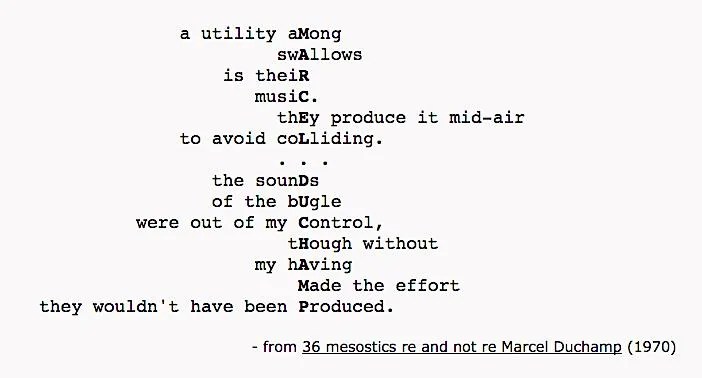
Cage’s mesostic may be difficult to make out there, so a graphic might work better:
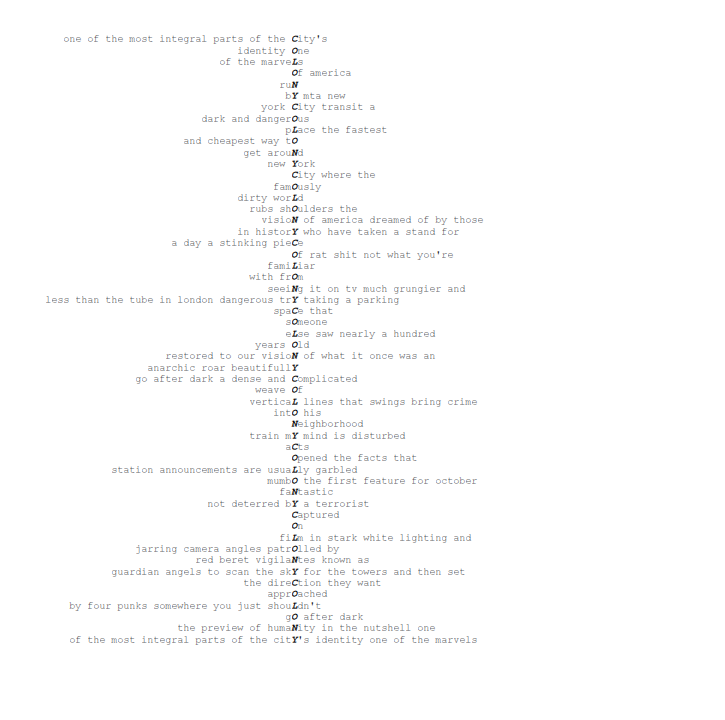
Then again, the best way to understand it might be to try to write one yourself (dare I say “anti-write” since once again, the process violates all those tropes about originality that have been drummed into us) at this site where a software program has automated the process. I’ve used it myself, enjoying the concrete nature of the form:
Just to show how far chance can go with Cage, here is an attempt to transcribe a little of his Lecture IV the fourth part of Empty Words, which, as described on his webpage: “a marathon text drawn from the Journals of Henry David Thoreau. This is one of Cage’s most sustained and elaborate moves toward the “demilitarization” of language, in four parts: Part I omits sentences, Part II omits phrases, and Part III omits words. Part IV, which omits syllables, leaves us nothing but a virtual lullaby of letters and sounds.”
3 XI 325-7 ry 4 II 430-2t um 5 I 174-6 me 6 XIV 332-4 for 7 XIII 24-6 be
and so on.
It’s not “I wandered lonely as a cloud…” But then we already have that, so why not keep moving into new territory?
Baby Hanuman mistook the sun for a ripe mango and sprang from earth to sky with mouth open wide: ______________________________________________________ He collided with Rahu the shadow planet on his journey to eclipse the sun. He irritated Surya the sun god by slavering him with saliva. He pissed off Indra the god of order with his cosmic error. —————————————————————— Mouth burned, jaw broken, pride bruised Hanuman sitting Shiva and walking backwards facing Surya in atonement invented yoga sun salutation and made mistakes a mitzvah.
This one is unpublished and likely unpublishable, so no reason not to put it up here. I’ve been writing a number of these lately in the style of Michael McClure, obvious to anyone who knows his work (and why wouldn’t you?). His mad sonnets were very personal and grew out of his dark night of the soul while I almost never write poems about personal feelings or states of mind. I am happy to write from a shared consciousness of mythology and public language. Not meditative but mediative. Some call that plagiarism. I call it Jamocha Almond Fudge. Or plagiarism. Anyway, I do like the formal madness of McClure’s sonnets, the way they break out of the form and violate the shapely to instead emphasize shape.
On this inauguration day, the news is rife with talk of the ceremony, the weather, the new round of pardons, illegal immigration, Chinese spies, inflation, etc, but one vital topic has been ignored. Facial hair. J.D. Vance’s restrained, well-groomed beard is making history.
How long has it been since this country has had any facial hair in the Oval Office? Quite a long time as it turns out.
Sure, Al Gore grew a beard but only after he termed out as VP and lost his presidential bid to Bush.
Why so clean-shaven in recent decades? Bolsheviks! It was those damn Bolshies who made the stache look so suspect. Technology may have played a hand as well: electric razors made the arduous process of strop-soak-soap-shave faster, easier, and more autonomous. Disposable razors were even more instrumental in this regard.
And then there are the grannies. You know, “straighten up, comb your hair, wash your face.” The universal granny command to keep things spic-and-span. Which translated to a distrust for any hooligan, beatnik, hippy, subversive who didn’t. Or as my granny put it, “I always believe a man with a beard has something to hide.
So, in the run for an office in which the slightest gaff can cost you a full point, and loss by single points is not uncommon, everybody decided to go clean for Gene.
Looking over presidents, none has sported facial hair above or below the lips since William Howard Taft rocked a luxurious imperial handlebar during his 1909–1913 term.
Veeps held onto the hair a little longer with Charles Curtis going with a bushy painter’s brush while serving under Calvin Coolidge in his 1929-1933 term. Maybe Silent Cal really wanted him to shear it but couldn’t spare the syllables to tell him.
Many fine staches preceded Curtis such as Thomas R. Marshall’s chevron 1913-21, Charles W. Fairbanks’ massive walrus plus van dyke 1905-9, and Teddy Roosevelt’s near-horseshoe worn as veep for six months before McKinley’s death put him on top.
But Chester A. Arthur’s massive muttonchops aside, no one in the second seat has gone full Beardo since Schuyler Colfax’s Mennonite turn during U.S. Grant’s first term.
You don’t have to go that far back to find the man in the top spot letting his freak flag fly with an ear to ear commitment of full fur. Benjamin Harrison in his single term from 1889 to 1893 (did it cost him a second?) had a mid-length graybeard.
So, as of this moment, Vance brings in the first soup strainer on a veep since 1933, the first full beard since 1873. And if he does become POTUS, he’ll be the first since 1893 to wear the full and proper masculine attire. Or, as my granny would say, he’ll be the first Prez “with something to hide.” (uh, no, grandma, there have been a few others, I think).



 Jedediah Smith