As a writer with a backlog of unpublished stories and novels, this question concerns and worries me. The Big Five are swallowing up smaller imprints; the corporate houses refuse to read unagented manuscripts; agencies are closed to new clients; self-publishing is turning into a revenue stream for everybody but writers–these are just a few topics worth exploring.
But for today, the topic is horror magazines. Just how many horror fiction periodicals are still out there taking submissions and paying a professional rate? Ever see pictures of magazine stands back in the 30s and 40s? The shelves were so crowded with story-based pulp magazines with those garish, crude, beautiful covers that they looked like a time-lapse slide of cells dividing and subdividing. And that’s exactly what the genres were doing: action divided into western, detective, horror, and war. War divided into sea, land, and air fighting. Air divided into titles focusing on aviators or dogfights or Zeppelins or … you get the picture.
We are in a reverse age: massive cellular collapse. Because the answer to my question, as of September 2025, is one. Uno. Eins. Not nada but its closest neighbor. Right now, only The Dark fits the criteria: horror fiction, professional, and open. And of the others that claim to still be a going concern:
Deadlands plans to reopen to submissions in December of this year
Cosmic Horror Monthly for one week in January of 26
Nightmare “hopes” for January of 26 as well
Pseudopod…is weird to mention; the others do print, electronically at least rather than on paper with all its attendant substantiality. Pseudopod posts audio clips of stories. I guess that counts as a periodical of sorts these days. Regardless, they are closed until Aug 26, when they’ll accept submissions for 10 days.
That’s it. All other titles either shut down or closed to submissions Until Further Notice.
Not much to nurture a community of writers. Not much to keep potential readers interested and entertained. Not much to provide a path to full book publication. Certainly nothing with which to interest the big media of gaming, comics, television, and movies. They get nearly all of their stories in-house. Hard to believe that once upon a time, a show like Alfred Hitchcock Presents could produce 7 seasons of 35+ episodes each, all based on stories from popular mystery magazines like Ellery Queen and Hitchcock’s own.
Which begs the question: how does Ellen Datlow in her yearly series The Best Horror of the Year–entitled with all the same humility that went into naming the “World” Series in baseball–find candidates to fill its table of contents? In a word: anthologies. Are they picking up the slack from the near-extinction of story-based magazines? Well, since many of them are closed to the hoi polloi by the aforementioned gatekeepers of corporations and literary agencies, I’d say no. But that’s a subject for my next newsletter.
Before I sign off, one more question. Am I wrong? I’d love to be. Please comment if you know of any mags I have missed that fit the criteria: horror fiction, professional rates, open to submissions.
Terry Bisson died a year and a month ago. At the time, I knew of only one work by him, the surreal little SF playlet called “They’re Made Out of Meat.” I don’t know why I did not search out more of his writing, but just recently I have. And I’m glad I did. The short story (mainly SF) seems to have been his best form. And he has even shorter pieces — I’ve seen them called dialogues, but playlet works for me — that put his in the territory of Russell Edson and Joe Frank, two of my main dudes. So, here’s a nifty little number called “Toxic Donut”:
HI, I’M RON, the Host’s Chief Administrative Assistant, but you can just call me Ron. Let me begin, at the risk of seeming weird, by saying congratulations.
Of course I know. I’ve been doing this show every year for six years; how could I not know? But look at it this way, Kim—do you mind if I call you Kim? You have been chosen to represent all humanity for one evening. All the birds and beasts too. The worms and the butterflies. The fishes of the sea. The lilies of the field. You are, for one half hour tonight, the representative of all life on the planet. Hell, all life in the Universe, as far as we know. That calls for congratulations, doesn’t it? You have a right to be proud. And your family, too.
Did you, I mean do you have a family? How nice. Well, we all know what they’ll be watching tonight, don’t we? Of course, I know, everybody watches it anyway. More than watch the Academy Awards. Eight to ten points more. A point is about thirteen million people these days, did you know that?
Okay. Anyway. Have you ever been on TV before? “Long shot at a ball game”—that’s good. I loved Bill Murray too. God rest his soul. Anyway. Okay. TV is ninety-nine percent preparation, especially live TV. So if you’ll walk over here with me, let’s take this opportunity to run through the steps for our lighting people, as well as yourself; so you will be able to concentrate on the Event itself.
After all, it’s your night.
Watch your step. Lots of wires.
Okay. We call this Stage Left. At 8:59, one minute to Airtime, one of the Girls will bring you out. Over there, in the little green outfits. What? Since you’re a woman it should be guys in bikinis? I get it, a joke. You have quite a sense of humor, Kim. Do you mind if I call you Kim?
Right, we did.
Anyway. Okay. You’ll stand here. Toes on that mark. Don’t worry, the cameras won’t linger on you, not yet. You’ll just be part of the scene at the beginning. There will be one song from the International Children’s Rainbow Chorus. “Here Comes the Sun,” I think. All you have to do is stand here and look pretty. Dignified, then. Whatever. You’re the first woman in two years, by the way; the last two Consumers were men.
I don’t know why, Consumers is just what we call them; I mean, call you. What would you want us to call you?
That’s another joke, right? Whatever.
Okay. Anyway. Song ends, it’s 9:07. Some business with the lights and the Host comes on. I don’t need to tell you there’ll be applause. He walks straight up to you, and—kiss or handshake? Suit yourself. After the handshake, a little small talk. Where you’re from, job, etc. Where are you from, by the way?
How nice. I didn’t know they spoke English, but then it was British for years, wasn’t it?
Anyway. Okay. Don’t worry about what to say; the Host has been briefed on your background, and he’ll ask a question or two. Short and sweet, sort of like Jeopardy.
To meet him? Well—of course—maybe—tonight right before the show, if time allows. But you have to understand, Mr. Crystal’s a very busy man, Kim. Do you mind if I call you Kim?
Right, we did. I remember. Sorry.
Okay. Anyway. A little ad-lib and it’s 9:10. I have it all here on my clipboard, see? To the minute. At 9:10 there’s some business with the lights, then the Girls bring out the Presidents of the Common Market, the African Federation, the Americas, Pacific Rim, etc. Five gentlemen, one of them a lady this year, I believe. There’s a brief statement; nothing elaborate. “Your great courage, protecting our way of life” sort of thing. A few words on how the Lottery works, since this was the first year people were allowed to buy tickets for others.
I’m sorry you feel that way. I’m sure voluntary would be better. But somebody must have bought you a ticket; that’s the way it works.
Anyway. Okay. Where were we? 9:13, the Presidents. They have a plaque that goes to your family after. Don’t take it; it’s just to look at. Then a kiss; right, handshake. Sorry. I’ll make a note of it. Then they’re out of here, Stage Right. Don’t worry, the Girls manage all the traffic.
Okay. 9:14, lights down, then up on the Native People’s presentation. You’re still standing here, Stage Left, watching them, of course. You might even like it. Three women and three men, clickers and drums and stuff. While the women dance, the men chant. “Science, once our enemy, now our brother” sort of thing. You’ll feel something on the back of your neck; that’s the wind machine. They finish at 9:17, cross to here, give you a kind of bark scroll. Take it but don’t try to unroll it. It’s 9:18 and they’re out of here, Stage Left. That’s the end of the—
What? No, the corporations themselves don’t make a presentation. They want to keep a very low profile.
Anyway. Okay. 9:19 and that’s the end of the warm-up, as we call it. The Host comes back out, and you walk with him—here, let’s try it—across to Center Stage. He’ll help you stay in the spotlight. He admires the scroll, makes a joke, ad-lib stuff; don’t worry about it. He’s done it every year now for six years and never flubbed yet.
There won’t be so many wires underfoot tonight.
Okay. It’s 9:20. You’re at Center Stage, toes here. That’s it, right on the mark. There’s more business with the lights, and the Host introduces the President of the International Institute of Environmental Sciences, who comes out from Stage Left. With the Donut. We don’t see it, of course. It’s in a white paper sack. He sets it here, on the podium in front of you.
He stands out there, those green marks are his—we call him the Green Meany—and gives his Evils of Science rap, starting at 9:22. “For centuries, poisoned the Earth, fouled the air, polluted the waters, etc., etc.” It’s the same rap as last year but different, if you know what I mean. A video goes with it; what we call the sad video. You don’t have to watch if you don’t want to, just look concerned, alarmed, whatever. I mean it all really happened! Dead rivers, dead birds, dioxins. Two minutes’ worth.
Okay. Anyway. It’s 9:24, and he starts what we call the glad video. Blue sky, birds, bears, etc. Gives the Wonders of Science rap where he explains how they have managed to collect and contain all the year’s toxic wastes, pollutants, etc., and keep them out of the environment—
How? I don’t know exactly. I never listen to the technical part. Some kind of submolecular-nano-mini-mumbo-jumbo. But he explains it all, I’m pretty sure. I think there’s even a diagram. Anyway, he explains how all the toxic wastes for the year have been collected and concentrated into a single Donut. The fiscal year, by the way. That’s why the Ceremony is tonight and not New Year’s Eve.
Okay. Anyway. Hands you the bag.
Exits Stage Right, 9:27. Now it’s just you and the Host, and of course, the Donut, still in the bag.
It might be a little greasy. You can hold it at the top if you want to. Whatever.
Anyway. Okay. 9:28. You’ll hear a drumroll. It might sound corny now but it won’t sound corny then. I know because I’ve been here every year for six years, standing right over there in the wings, and I get a tear in my eye every time. Every damn time. The camera pulls in close. This is your moment. You reach in the bag and—
Huh? It looks like any other donut. I’m sure it’ll be glazed, if that’s what you requested.
Okay. Anyway. 9:29, but don’t worry about the time. This is your moment. Our moment, really, everybody in the world who cares about the environment, and these days that includes everybody. You reach in the bag, you pull out the Donut—
What happens next? I get it, still joking. I admire somebody with your sense of humor. Kim.
It’s you baby.
I want you dropping the red bandanna between
	our headlights pointed toward the cliff beyond
I want the lacy edge of your push-up bra pushing
	up beyond your low-cut top to be
	the last sight I see before I pedal to the metal
	this hot rod toward oblivion
But you’re no Natalie Wood sweetheart, you’re bad
I’ve seen you in 1000 movie matinees, an afternoon cinema slut
	the gangster’s moll
	the hoodlum’s squeeze
	the vampire’s wife
	the creature feature monsterbait
	number one slit in the lesbian biker pack
	the razor chick in the all-girl gang
	the tough broad sidekick
	not the heartthrob but the handjob
	not the heroine but the hard-on
with lips cherry red
	kohl-ringed eyes
	stiletto heels snapping castanets
	hunks of skin under your nails
	cleavage heaving beneath reptile hands
	Tura Satana’s legs, Kitten Natividad’s jugs,
	Bettie Page’s ass, Ingrid Pitt’s fangs
	honey skin thigh jiggling giggling
	sweet hole sticky lipped
You’re my personal Jayne Mansfield, head intact
My puberty’s centerfold dream realized in panting flesh
and I’m still in the third row, ordering
	another jumbo popcorn, feet
	propped up on the next row, waiting
	for a flash of pink that never quite
	makes it past the cut of the American
	International Pictures’ censor
I’ve seen you play the sweater girl opposite Steve McQueen,
	saving the world from aliens while
	making out in the back seat, civilization
	hanging by one bra strap
Lounge back in white trash splendor, lit up in the glare
	of a stag film flickering on the fake
	paneling of a basement rec-room.
Pull the switchblade from your beehive baby, the one
	you stuck in Jeff Hunter’s back when he
	fell for you like a schoolboy but you were
	a dropout tired of a diet of white bread
You’re not a nice girl and I never wanted you to be
Smear the popcorn butter Bettie,
	right across that swell looking mug
Swing your Fender Telecaster as you and Wanda Jackson
	pound the shit out of Jailgirl Rock
I’ve heard your pumps clicking down a wet brick midnight
	alley the hitman on your trail
I’ve seen you punch out the sorority girl at the sock hop
	then get belly shot by the friendly cop
	O’Malley in the end
keep riding that Harley mama, till the blood runs down
	your legs
keep tossing that dynamite
	blowing the side panels off Continentals
keep tossing back bourbons neat while
	the college boys cough on crème de mint
keep your nails long and jungle red clawing
	your way from the cheap sharecropper’s cabin
	to the hard grit sidewalks of LA
keep shaking that wild bikini, squirming in the painted-on
	leather, and shimmering
	the cheap porno tinsel on the stripper runway
keep dancing on the edge of that cliff
	as I race my souped-up Chevy
	out into the dread air
keep loading the passion, both barrels blasting, sending
	me over the cliff for one last look of that lacy bra,
	one last look on the screen.
But you’re real baby,
	no mere 2D projection of our desire on the silver screen
	of the mind.
You’re all 3D –
no glasses necessary.
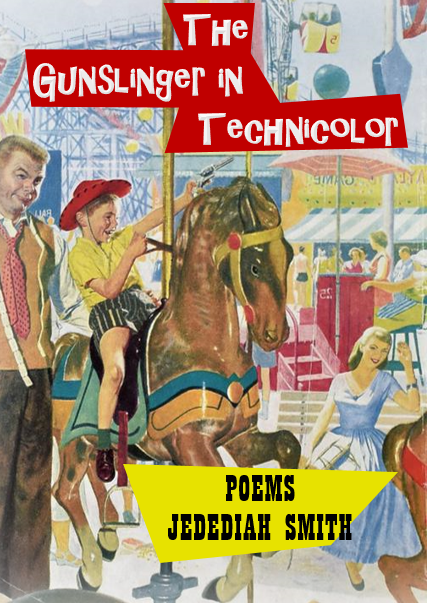
A selection from The Gunslinger in Technicolor, published by Mount Diablo Books and available in print from Amazon.
This novel might be off-putting to readers of current SF or fantasy novels. Its approach to prose and plot is very different from contemporary works, and I note that SF novels of the 50s and 60s often approached plot as an exploration of ideas. It’s not that they weren’t often entertaining and well structured. But novels by Delaney, Spinrad, Dick, LeGuin and many others seemed to develop their characters and setting and plots in the service of theme, developing and testing ideas, and extrapolating social changes from technological inventions or scientific discoveries. And once a hypothesis had been established and tried and evaluated, the novel would end. Often around the 250 page mark.
Today, the focus is on immersion into story and setting. Readers want long-term escapism for their money. So the prose is clear and simple, there is an emphasis on long changing relationships and fortunes of characters, and the page counts are massive, often stretching into a series of novels (trilogies? not a chance! why drop an established and successful brand) or “world” novels without end.
Delany not only allowed his prose to be difficult, he delighted in it. He loved to throw the reader into a new world with new rules and new meanings, while providing them with few road signs. He often described his love for work by authors who would challenge readers to put together hints and make inferences in order to make sense of this new creation. Long exposition and explanation would make it too easy and rob the reader of the joy of discovery, of making connections and leaps on their own, of inference, which is really the process of making love to literature. Nova weaves a tapestry of its influences and creates an organic whole.
Of course, Delany, Brunner, Pynchon, and Spinrad all had at least one magnum opus that pushed the page count well beyond the 500 page mark. But these were not SF soap operas following long character arcs. In each case, these were the authors’ most challenging, experimental, and difficult works.



 Jedediah Smith